Agile Change vs. Scope Creep: When Is Change Expected—and When Is It Uncontrolled?
 admino
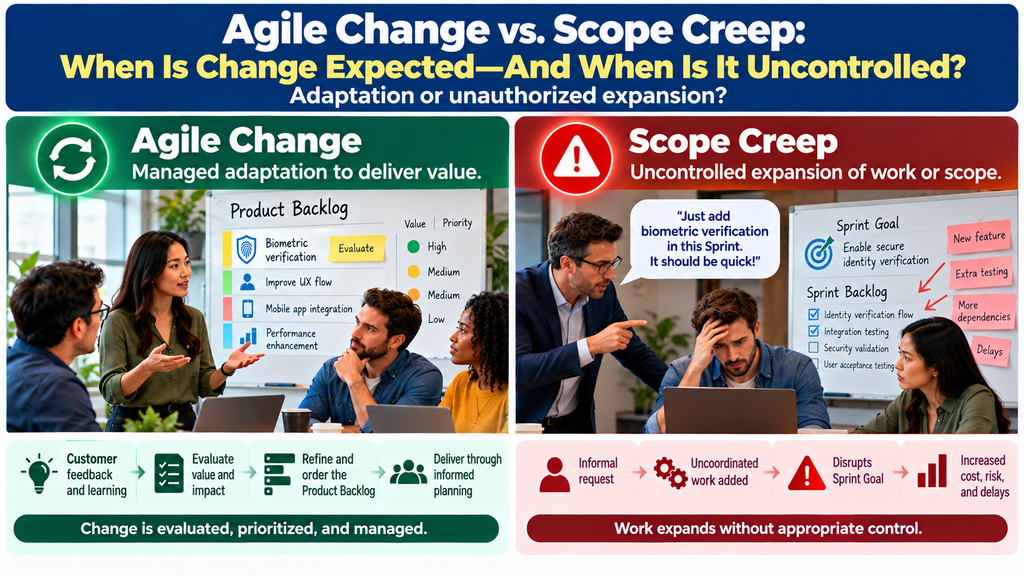
Adaptation or unauthorized expansion?
A financial services organization is developing a digital customer onboarding platform using Scrum within a hybrid project.
The Scrum Team is working toward a Sprint Goal: enabling customers to complete secure identity verification.
During a product demonstration, a senior stakeholder proposes biometric verification. The feature could improve security and customer convenience, but it would require additional integration, privacy assessment, and testing.
The Product Owner recognizes its potential value but has not yet evaluated its priority or delivery implications.
Later, the stakeholder contacts a Developer directly:
“Can you add biometric verification during this Sprint? It should be a small enhancement.”
The Developer begins implementation without coordinating with the Product Owner or other Developers.
Within days, integration testing falls behind, and the Sprint Goal is threatened.
When the Project Manager (PM) raises concerns, the stakeholder responds:
“Isn't Agile supposed to welcome changing requirements?”
What should the project manager do?
Reject the feature? Submit a formal change request? Or allow the Developer to continue because Agile encourages adaptation?
The answer depends on more than whether the feature is valuable.
Agile change is managed adaptation. Scope creep is uncontrolled expansion.
For PMP® candidates, the essential distinction is whether the change has been evaluated, prioritized, incorporated through appropriate decision-making, and managed within relevant delivery and governance boundaries.
1. Agile Change vs. Scope Creep: The Fundamental Difference
Agile approaches welcome learning and adaptation. However, welcoming change does not mean implementing every request immediately.
| Dimension | Agile Change | Scope Creep |
|---|---|---|
| Nature | Managed adaptation to new information | Uncontrolled expansion of work or scope |
| Typical trigger | Customer feedback, learning, risk, market change | Informal requests, unclear boundaries, unapproved additions |
| Evaluation | Value, impact, feasibility, dependencies | Often incomplete or bypassed |
| Decision-making | Appropriate product and governance authority | Decision rights ignored or unclear |
| Backlog treatment | Transparently evaluated, refined, and ordered | Work added without appropriate consideration |
| Delivery impact | Incorporated through informed planning | May disrupt goals, capacity, cost, or schedule |
| Visibility and control | Proportionate transparency and authorization | Inadequate control of commitments or impacts |
| PMP interpretation | Respond to change while protecting value | Restore control without suppressing useful adaptation |
Two distinctions matter.
First, a scope increase is not automatically scope creep. A properly evaluated and authorized expansion may be a legitimate change, even when it increases cost or duration.
Second, placing a request in the Product Backlog does not automatically authorize its immediate implementation.
The critical question is how the team manages the change.
2. Why Agile Welcomes Change
The Agile Manifesto encourages welcoming changing requirements, even late in development, when doing so creates customer advantage.
This recognizes that knowledge evolves during delivery.
Customer feedback may reveal misunderstood needs. Market conditions may change product priorities. Security findings or regulatory developments may require a different approach.
Iterative delivery creates opportunities to inspect working results and adjust future work before further investment.
However, adaptability requires judgment.
A newly requested feature may create substantial value, but it may also introduce dependencies, costs, risks, or conflicts with existing commitments.
PMP principle: Agile welcomes useful change, not uncontrolled commitments.
3. Product Scope vs. Project Scope: What Is Actually Changing?
This distinction is particularly important in Agile and Hybrid projects.
Product scope concerns the product’s features, functions, and capabilities.
Project scope concerns the work required to deliver the project’s intended results.
The two are related but not identical.
| Dimension | Product Scope | Project Scope |
|---|---|---|
| Primary concern | Product features and capabilities | Work required to deliver project outcomes |
| Key question | What should the product do? | What work must be performed? |
| Agile adaptation | Product Backlog evolves as learning occurs | Delivery plans and commitments are managed |
| Typical considerations | Value, usability, functionality, quality | Resources, schedule, cost, dependencies, governance |
| Decision emphasis | Product Owner and relevant collaborators | Applicable project and organizational authority |
Consider biometric verification.
Adding the feature changes the product’s intended capabilities.
It may also increase project work through integration, privacy assessment, testing, and deployment activities.
However, not every Product Backlog adjustment requires changing an approved project baseline.
For example, the Product Owner might replace a lower-value feature with biometric verification while remaining within existing funding and release constraints.
Alternatively, the feature may require additional funding or a contractual amendment.
The important question is not simply whether product scope changes, but whether the change also affects governed project commitments.
4. What Is Scope Creep?
Scope creep occurs when additional work or deliverables are introduced without adequate control of their impact on agreed objectives, priorities, resources, or commitments.
It often develops through apparently small decisions:
- Informal stakeholder requests implemented without evaluation.
- Developers adding unrequested functionality.
- Unclear acceptance expectations.
- Repeated additions without reconsidering capacity.
- Changes that bypass applicable authorization.
- Unmanaged commitments affecting cost, schedule, or deliverables.
A properly evaluated and authorized scope increase is a managed change, even when it expands the total amount of work.
Gold Plating vs. Scope Creep
Gold plating means adding features or enhancements beyond what was requested or agreed, often with good intentions.
For example, a Developer adds advanced facial-recognition analytics when the agreed requirement is document verification.
The enhancement may introduce privacy risks, additional testing, and maintenance costs without justified value.
Gold plating can contribute to scope creep, but the terms are not identical.
More functionality does not automatically mean more value.
5. Who Has Authority to Accept or Prioritize Change?
Different decisions belong to different Scrum accountabilities and organizational authorities.
Product Owner
The Product Owner is accountable for maximizing product value and managing the Product Backlog effectively, including ordering Product Backlog items.
Stakeholders may propose changes, but stakeholder seniority alone does not determine Product Backlog priority.
Developers
Developers are accountable for creating and adapting the Sprint Backlog and organizing their work.
They determine how to carry out the work needed to achieve the Sprint Goal.
The Product Owner cannot simply direct Developers to add work to the Sprint without appropriate collaboration.
Likewise, Developers should not independently implement a stakeholder’s new feature without considering product priorities and Sprint commitments.
Scrum Master
The Scrum Master supports Scrum effectiveness and helps participants understand Scrum accountabilities.
This may include coaching stakeholders and team members on appropriate change-management interactions.
Project Manager
A PM is not a prescribed Scrum accountability.
In a hybrid project, the PM may coordinate external dependencies, contractual commitments, funding constraints, and governance requirements within assigned authority.
Sponsor or Change Control Board
Some changes require authorization beyond product-level prioritization.
A contract amendment or funding increase may require sponsor approval or a formal change-control process.
Product Owner accountability for Product Backlog management does not automatically override contractual, regulatory, or organizational governance requirements.
6. Product Backlog Change vs. Sprint Backlog Change
The Product Backlog is an emergent, ordered list of what is needed to improve the product.
As new information emerges, the Product Owner may refine and reorder it.
The Sprint Backlog contains the Sprint Goal, selected Product Backlog items, and the Developers’ actionable delivery plan.
Before Sprint Planning
The Product Owner evaluates and orders new requests based on value, risk, and dependencies.
During Sprint Planning
The Scrum Team establishes the Sprint Goal.
Developers select Product Backlog items through discussion with the Product Owner and create the delivery plan.
During the Sprint
The Sprint Backlog is not frozen.
The Scrum Guide establishes three important boundaries:
- No changes are made that would endanger the Sprint Goal.
- Quality does not decrease.
- Scope may be clarified and renegotiated with the Product Owner as more is learned.
Developers adapt the Sprint Backlog throughout the Sprint.
A new feature may be considered during the Sprint, but it should not be introduced through unilateral direction that threatens the Sprint Goal.
What About Unfinished Work?
Unfinished Product Backlog items are not automatically committed to the next Sprint.
They return to appropriate Product Backlog consideration and future planning.
PMP principle: Protect the Sprint Goal while allowing informed scope negotiation and adaptation.
7. Optional Enhancement vs. Mandatory Change
Not all changes have the same urgency or consequences.
Case A — Optional Enhancement
A stakeholder proposes biometric verification to improve customer convenience.
The feature may create value, but there is no immediate obligation to implement it.
The Product Owner can evaluate its priority and determine how it fits into future product planning.
Interrupting the current Sprint may be unnecessary.
Case B — Mandatory Security Requirement
A newly discovered vulnerability makes the existing identity-verification approach unsafe for release.
The Scrum Team cannot ignore the issue just because it wasn’t included in Sprint Planning.
The team should assess the risk, product implications, and appropriate response.
Relevant security, compliance, or release controls may also apply.
An urgent requirement does not automatically justify bypassing Scrum accountabilities or governance.
However, its urgency may require immediate inspection and adaptation.
What If the Sprint Goal Becomes Obsolete?
If a fundamental change makes the Sprint Goal obsolete, the Product Owner has the authority to cancel the Sprint.
This is an exceptional response, not a routine way to accept new features.
PMP principle: Evaluate urgency, obligations, and risk—not merely whether the request was included in the original plan.
8. Does Every Agile Change Require Formal Change Control?
No.
The appropriate process depends on what the change affects and which governance requirements apply.
Product-Level Adaptation
Many changes can be managed through Product Backlog management and iterative planning.
Examples include refining requirements, reordering future features, incorporating customer feedback, and adjusting implementation details.
These activities do not automatically require a Change Control Board.
Governed Project-Level Change
Formal approval may be required when a proposed change affects:
- An approved funding ceiling.
- A contractual deliverable.
- A regulatory commitment.
- A controlled project baseline.
- A committed external release obligation.
For example, biometric verification may require funding beyond the approved project limits.
The Product Owner can evaluate product value, while the PM coordinates any required project-level approval.
Neither “all Agile changes require formal approval” nor “Agile changes never require formal approval” is universally correct.
9. The Hidden Cost of Uncontrolled Change
Scope creep can create consequences beyond additional development effort.
A stakeholder may describe a feature as a minor enhancement.
However, implementation may require integration, security assessment, regression testing, documentation, and additional approvals.
Three small requests may collectively consume more capacity than a major planned feature.
Uncontrolled additions can also increase work in progress, create technical debt, weaken forecast reliability, and distract Developers from the Sprint Goal.
Evaluate the total delivery impact—not merely the apparent size of the request.
10. One Request, Three Different Outcomes
Return to the biometric-verification request.
Outcome A — Controlled Agile Adaptation
The stakeholder presents the idea to the Product Owner.
The Product Owner evaluates its value, risk, and dependencies, then refines and orders the Product Backlog.
Developers consider the work through appropriate planning.
Outcome B — Uncontrolled Scope Expansion
The stakeholder directs a Developer to implement the feature immediately.
The Developer begins work without appropriate coordination.
Integration testing is delayed, and the Sprint Goal becomes threatened.
Outcome C — Governed Hybrid Change
The feature is valuable but requires additional funding, a contract amendment, or regulatory approval.
Product-level evaluation proceeds alongside the necessary project-level governance process.
The same feature can be handled through different legitimate paths depending on its impact and decision boundaries.
11. Project Reasoning Lab: The Five-Question Change Boundary Test
When a PMP scenario describes changing requirements, new features, or unauthorized work, use this framework.
1. Value
What customer, business, or risk-related benefit does the change provide?
Determine whether the request addresses a meaningful need.
2. Boundary
What existing Sprint Goal, scope, capacity, or commitment would it affect?
Identify delivery and governance constraints.
3. Authority
Who has the accountability or delegated authority to make the decision?
Distinguish product prioritization, Developers’ planning, and organizational approvals.
4. Path
Should the change enter Product Backlog refinement, Sprint-level negotiation, or formal change control?
Choose the process appropriate to the decision.
5. Adaptation
How should plans, priorities, forecasts, and communications change?
Ensure that decisions lead to coordinated action.
Remember the Sequence
Value → Boundary → Authority → Path → Adaptation
This is a Project Reasoning Lab study framework, not an official PMI or Scrum procedure.
Applying the Test to the Biometric Request
First, make the request and work already underway transparent.
Next, assess value, urgency, dependencies, and Sprint Goal impact.
Identify the appropriate product and project decision-makers.
Determine whether the feature belongs in current Sprint negotiation, future Product Backlog ordering, or a governed change process.
Finally, update plans and communicate the decision.
Evaluating a request does not mean automatically approving it.
12. Four Practical PMP Scenarios
Scenario A — A Stakeholder Requests a Feature Mid-Sprint
A senior stakeholder asks a Developer to add functionality unrelated to the Sprint Goal.
Best response: Make the request visible to the Product Owner for evaluation while protecting the Sprint Goal from uncoordinated disruption.
Tests: Decision authority and Sprint Goal protection.
Scenario B — Customer Feedback Changes Product Priorities
Customers identify a usability problem after reviewing an Increment.
Best response: Support the Product Owner in evaluating feedback and adapting Product Backlog priorities.
Tests: Agile responsiveness and value delivery.
Scenario C — Regulatory Requirements Change
A new regulation requires additional verification controls before release.
Best response: Assess compliance obligations, urgency, product implications, and applicable governance requirements.
Tests: Risk, compliance, and hybrid change control.
Scenario D — Developers Add Unrequested Features
Developers independently add advanced analytics because they believe stakeholders will appreciate them.
Best response: Address the unrequested work, clarify product priorities, and reinforce appropriate decision-making.
Tests: Gold plating and scope control.
13. Advanced PMP Scenario Challenge: Two Plausible Answers
A hybrid project uses Scrum to develop a regulated customer onboarding platform.
Midway through a Sprint, a senior stakeholder requests biometric verification to improve security.
The feature could provide value but requires additional testing and may affect an approved contractual milestone.
A Developer has started implementing it without discussing the change with the Product Owner.
What should the project manager do first?
A. Coordinate with the Product Owner and Developers to assess the feature’s value, Sprint Goal impact, and governance implications, while addressing the uncoordinated work already underway.
B. Ask the Product Owner to prioritize the feature in the Product Backlog and have Developers determine whether it can be incorporated into the current Sprint.
C. Initiate a formal change request to evaluate the contractual impact before allowing any further product-level discussion.
D. Ask the Scrum Master to coach the Developer on Scrum accountabilities and allow the Product Owner to determine the feature’s priority independently.
Correct Answer: A
Option A recognizes the immediate coordination problem while preserving appropriate Scrum accountabilities and governance.
Why B Is Tempting but Incomplete
It respects Product Backlog and Sprint-level decision-making.
However, it does not explicitly address the uncoordinated work already underway or the possible contractual implications.
Why C Is Incorrect
Formal change control may be necessary, but the scenario does not establish that all product-level discussion must wait for approval.
The appropriate governance path should be determined through impact assessment.
Why D Is Tempting but Incomplete
Scrum coaching may be useful.
However, coaching alone does not fully address delivery disruption or potential contractual risk.
The Deeper PMP Lesson
The strongest response preserves adaptability while restoring coordinated decision-making.
It neither rejects change simply because it is new nor accepts it merely because it appears valuable.
Evaluate the opportunity, protect the Sprint Goal, respect decision authority, and apply governance where required.
14. Five Common PMP Traps
| Trap | Better Reasoning |
|---|---|
| Agile welcomes every requested feature immediately | Welcome learning; evaluate value and impact |
| Every new requirement is scope creep | Managed adaptation is expected |
| Sprint scope can never change | Scope may be clarified and renegotiated |
| Product Owner authority overrides all governance | Product decisions and external commitments may coexist |
| All Agile changes require Change Control Board approval | Apply formal controls where required |
The central mistake is confusing flexibility with the absence of control.
Agile approaches manage uncertainty through inspection, adaptation, and clear accountabilities.
15. Predictive, Agile, and Hybrid: How Is Change Managed?
Predictive Projects
Changes affecting approved baselines may require impact assessment, integrated change control, and authorization under the project’s governance approach.
Agile Projects
Teams evaluate emerging requirements through product prioritization, iterative planning, and appropriate accountabilities.
Hybrid Projects
Product-level adaptation may coexist with formal controls for contracts, funding, regulatory obligations, and other governed commitments.
PMP principle: Tailor change management to the delivery approach and the commitments affected.
16. Final Takeaway: Welcome Change Without Losing Control
Return to the biometric-verification request.
The feature may be valuable. The problem is implementing it without evaluating its impact, respecting decision authority, or protecting existing commitments.
The Product Owner can evaluate its product priority. Developers can assess delivery implications. The PM can coordinate applicable project-level governance.
Agile change is expected when learning reveals a better path to value. Scope creep occurs when work expands without appropriate evaluation, authority, or control.
For PMP scenarios, remember:
Value → Boundary → Authority → Path → Adaptation
And apply one final principle:
Agile does not eliminate change control. It changes how many decisions are made. The goal is not to prevent change, but to ensure that change delivers value without creating uncontrolled commitments.
Clear Thinking. Better Projects.