Make-or-Buy Decision: What Is the PMP Scenario Really Asking?
 admino
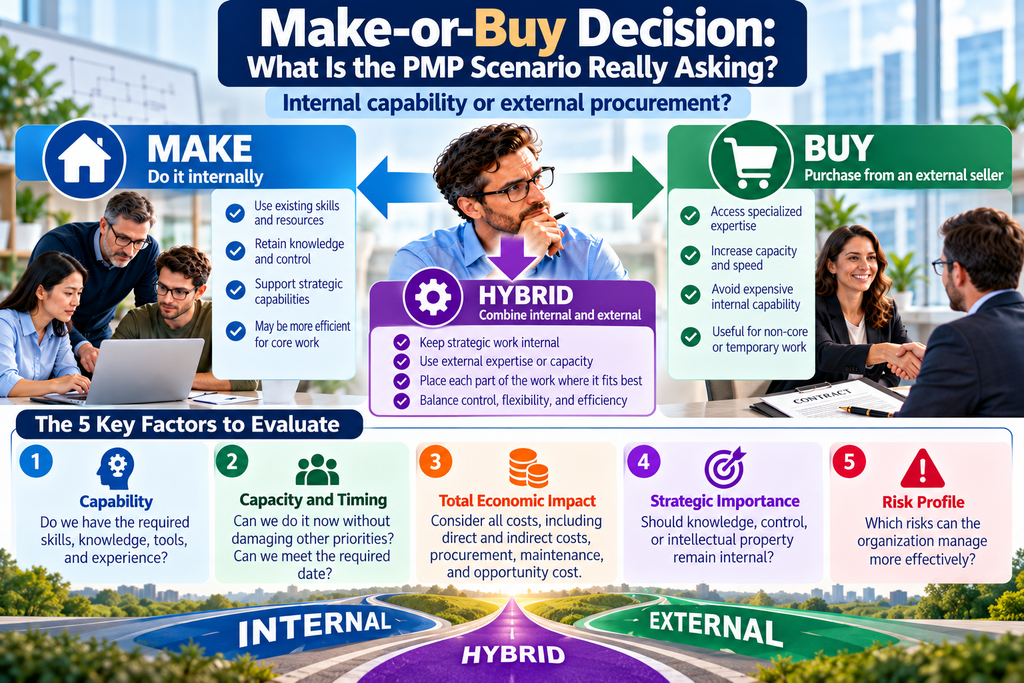
Internal capability or external procurement?
A project needs a product, service, or capability.
Should the organization:
- perform the work internally,
- purchase it from an external seller,
- or use a hybrid approach?
At first glance, this may look like a cost question.
It is broader than that.
A make-or-buy decision is really about:
- capability,
- capacity and timing,
- total economic impact,
- strategic importance,
- risk.
A useful Project Reasoning Lab principle is:
Make-or-buy asks where the work should live — inside the organization, outside it, or across both.
The exam may frame the choice as make versus buy, but the underlying reasoning can still support a mixed sourcing approach when different parts of the work belong in different places.
The cheapest option is not automatically the best one.
1. Start With Five Questions
Before deciding whether to make, buy, or combine both approaches, ask:
1. Do we have the capability?
Does the organization have the required:
- skills,
- knowledge,
- tools,
- experience,
- technical capability?
2. Do we have the capacity — and can we meet the timing?
Even if the organization knows how to perform the work, can it do so now without damaging other priorities?
3. What is the total economic impact?
Consider more than the visible purchase price:
- direct cost,
- indirect cost,
- equipment,
- training,
- maintenance,
- procurement administration,
- vendor management,
- opportunity cost.
4. How strategically important is the capability?
Should knowledge, control, or intellectual property remain internal?
5. Which risk profile is more manageable?
Making and buying create different kinds of risk.
These five questions form the backbone of the decision.
2. Capability: Can the Organization Perform the Work?
Consider:
A project requires a specialized cybersecurity assessment.
If the organization already has:
- qualified professionals,
- appropriate tools,
- relevant experience,
internal delivery may be realistic.
If those capabilities do not exist internally, external procurement becomes more attractive.
The key question is:
Does the organization have the capability required to perform the work successfully?
3. Capacity and Timing: Can We Do It Now?
Capability and capacity are not the same thing.
Consider:
The internal engineering team has the necessary expertise but is already fully committed to a regulatory deadline.
The organization can perform the work.
But perhaps not now.
Or consider:
Building the internal capability will take six months, while a qualified seller can begin next week.
Buying may fit better.
Now reverse the situation:
Procurement will take months, while the internal team can start immediately.
Making may fit better.
The principle is:
Can do does not automatically mean can do now.
Timing can be decisive when one option can meet the required date and the other cannot.
4. Total Economic Impact Includes Opportunity Cost
Suppose:
An external seller quotes $100,000, while the internal estimate is $80,000.
Does that automatically mean the organization should make?
Not necessarily.
The internal option may also involve:
- training,
- equipment,
- supervision,
- maintenance,
- support,
- diversion of scarce resources.
The external option may involve:
- seller price,
- procurement administration,
- contract management,
- transition effort,
- vendor dependency.
There is also an opportunity-cost question:
What must the organization give up to choose this option?
If internal specialists are diverted from a higher-value initiative, the apparently cheaper option may create a higher economic cost.
So:
Compare total relevant economic impact, not just the visible price.
5. Strategic Importance Can Favor Internal Delivery
Some capabilities may be important enough that the organization wants to retain them internally.
Examples may include:
- proprietary technology,
- sensitive intellectual property,
- core operating knowledge,
- critical security capability,
- strategic decision-making.
External procurement may create concerns about:
- knowledge loss,
- vendor dependency,
- confidentiality,
- reduced direct control.
A useful principle is:
Some capabilities are worth retaining because losing the knowledge may cost more than outsourcing saves.
Strategic importance can also favor a hybrid approach.
For example:
The organization keeps architecture, product ownership, and sensitive knowledge internally while outsourcing specialized development.
That preserves strategic control while gaining outside capability.
6. External Expertise May Be More Efficient
Now consider:
The project requires specialized laboratory testing that the organization only needs occasionally.
Building the capability internally may require:
- expensive equipment,
- specialist staff,
- training,
- maintenance.
If qualified external providers already exist, buying may be more efficient.
External procurement may fit when:
- expertise is rare,
- demand is temporary,
- the work is non-core,
- maintaining internal capability would be expensive.
7. Make-or-Buy Does Not Have to Be Binary
The organization does not always need to choose:
100% make
or
100% buy
A hybrid approach may place different parts of the work where they fit best.
For example:
Keep internally
- architecture,
- product ownership,
- sensitive data,
- governance.
Source externally
- specialist development,
- testing,
- temporary capacity.
This can combine:
- retained strategic control,
- internal knowledge,
- external expertise,
- additional capacity,
- flexibility.
Sometimes the best sourcing decision is not choosing one side. It is deciding which work belongs where.
8. Risk Changes Depending on the Choice
Making internally creates one risk profile.
Buying externally creates another.
Internal delivery may create:
- resource risk,
- capacity pressure,
- skills-gap risk,
- internal schedule risk,
- opportunity cost.
External procurement may create:
- seller-performance risk,
- contract risk,
- vendor dependency,
- external schedule risk,
- reduced direct control.
A strong Project Reasoning Lab principle is:
Outsourcing does not remove risk. It changes the type and location of risk.
So ask:
Which risks can the organization manage more effectively?
9. Scenario: Strong Internal Capability and Capacity
The organization has an experienced development team with available capacity, and the work is closely connected to a core product.
Making internally may fit because the organization already has both the capability and the capacity, while retaining knowledge and control.
10. Scenario: Capability Exists, but Capacity Does Not
Internal specialists can perform the work, but they are already committed to another high-priority initiative.
Buying may fit because external sourcing can protect more valuable internal work.
The key question is:
Can we do this without damaging something more important?
11. Scenario: Rare Specialist Expertise
The project requires a highly specialized analysis that the organization does not normally perform.
Buying may fit if the need is temporary, the capability is non-core, and qualified sellers are available.
12. Scenario: Strategic Capability or Sensitive IP
The project involves proprietary algorithms that provide a competitive advantage.
Making internally — or using a hybrid model — may better protect intellectual property, knowledge retention, and strategic independence.
The lower external price may therefore not be the deciding factor.
13. Who Actually Makes the Decision?
Even after the analysis points toward make, buy, or hybrid, the sourcing decision may require approval beyond the project manager’s authority.
The PM may:
- analyze alternatives,
- identify risks,
- estimate impacts,
- make a recommendation.
But the final decision may involve:
- procurement,
- sponsor,
- functional management,
- governance,
- senior management.
So another useful question is:
Who has authority to approve the sourcing decision?
The project manager may recommend.
The final decision may belong elsewhere.
14. Quick Comparison
| Situation | Likely Direction |
|---|---|
| Strong internal expertise and available capacity | Make may fit |
| Internal resources are constrained | Buy may fit |
| Rare specialist expertise is required | Buy may fit |
| Strategic or IP-sensitive capability | Make or hybrid may fit |
| External seller can meet the required date materially faster | Buy may fit |
| Procurement lead time is excessive | Make may fit |
| Different parts of the work suit different sources | Hybrid may fit |
15. Three Common Traps
Trap 1: Cheapest Option Automatically Wins
No.
Cost, timing, capability, strategy, and risk all matter.
Trap 2: If We Can Do It, We Should Make It
Not necessarily.
Capability without available capacity may still make internal delivery impractical.
Trap 3: Outsourcing Transfers the Risk Away
No.
It replaces some internal risks with seller, contract, and dependency risks.
Final Takeaway
When a PMP scenario asks whether the organization should make or buy, ask:
Can we do it?
Can we do it now?
What does it really cost?
Should we retain the capability strategically?
Which risk profile is more manageable?
And remember that the answer may be:
make
buy
or
hybrid
Choose where the work should live based on capability, capacity, economics, strategy, timing, and risk — not price alone.
That is what the PMP scenario is really asking.