Project Reasoning
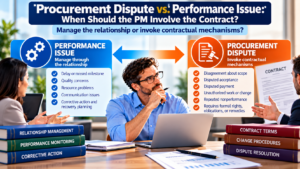
Procurement Dispute vs. Performance Issue: When Should the PM Involve the Contract?New!!
Learn how to distinguish a seller performance issue from a procurement dispute in PMP exam scenarios. Discover when collaboration and corrective action are appropriate—and when contractual obligations, authority, rights, or remedies require formal procurement involvement.
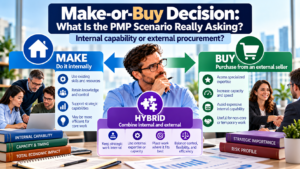
Make-or-Buy Decision: What Is the PMP Scenario Really Asking?New!!
Internal capability or external procurement? A project needs a product, service, or capability. Should the organization: At first glance, this may look like a cost question. It is broader than that. A make-or-buy decision is really about: A useful Project Reasoning Lab principle is: Make-or-buy asks where the work should live — inside the organization, […]
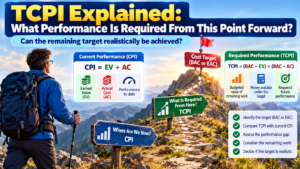
TCPI Explained: What Performance Is Required From This Point Forward?New!!
Learn how to interpret TCPI in PMP exam scenarios and determine the cost efficiency required to achieve BAC or EAC. Compare TCPI with current CPI, evaluate the performance gap, and decide whether the remaining cost target is realistically achievable.
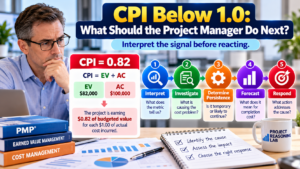
CPI Below 1.0: What Should the Project Manager Do Next?
Learn what CPI below 1.0 means in PMP exam scenarios and what the project manager should do next. Understand how to investigate the cause of unfavorable cost efficiency, distinguish temporary from persistent variance, assess forecast impact, and choose a response based on the underlying project condition.
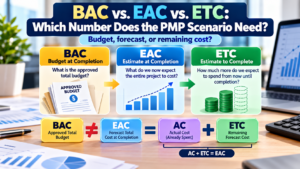
BAC vs. EAC vs. ETC: Which Number Does the PMP Scenario Need?
Learn how to distinguish BAC, EAC, and ETC in PMP exam scenarios. Understand the difference between the approved budget, the current total cost forecast, and the remaining expected cost—and how to identify the right metric before choosing a formula.
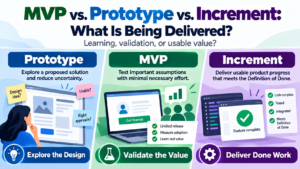
MVP vs. Prototype vs. Increment: What Is Being Delivered?
MVP, Prototype, or Increment—which one is your team actually delivering? Learn how prototypes reduce uncertainty, MVPs validate customer and business assumptions, and Scrum Increments deliver usable product progress. Explore practical PMP exam scenarios, the Definition of Done, and our Five-Question Delivery Purpose Test for making better Agile and Hybrid project decisions.
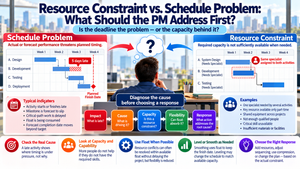
Resource Constraint vs. Schedule Problem: What Should the PM Address First?
Learn how to distinguish a resource constraint from a schedule problem in PMP exam scenarios. Understand how capacity, capability, float, resource leveling, and resource smoothing help determine what is actually driving schedule pressure—and what the project manager should address first.
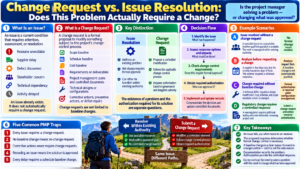
Change Request vs. Issue Resolution: Does This Problem Actually Require a Change?
Learn how to distinguish issue resolution from a change request in PMP exam scenarios. Discover when project managers can resolve problems within existing authority, when formal change control is required, and how to evaluate controlled changes, approval requirements, and project governance before taking action.
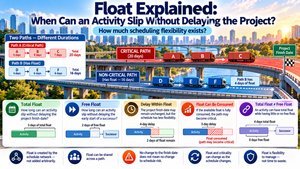
Float Explained: When Can an Activity Slip Without Delaying the Project?
Learn how float works in PMP exam scenarios, including the difference between total float and free float. Understand how delays consume schedule flexibility, affect successor activities and the project finish date, and can cause a non-critical path to become critical.

Fast Tracking vs. Crashing: Which Schedule Compression Technique Fits?
Learn how to choose between fast tracking and crashing in PMP exam scenarios. Understand how the critical path, activity dependencies, resource availability, cost, and risk determine which schedule compression technique fits — and why shortening an activity does not always shorten the project.