CPI Below 1.0: What Should the Project Manager Do Next?
 admino
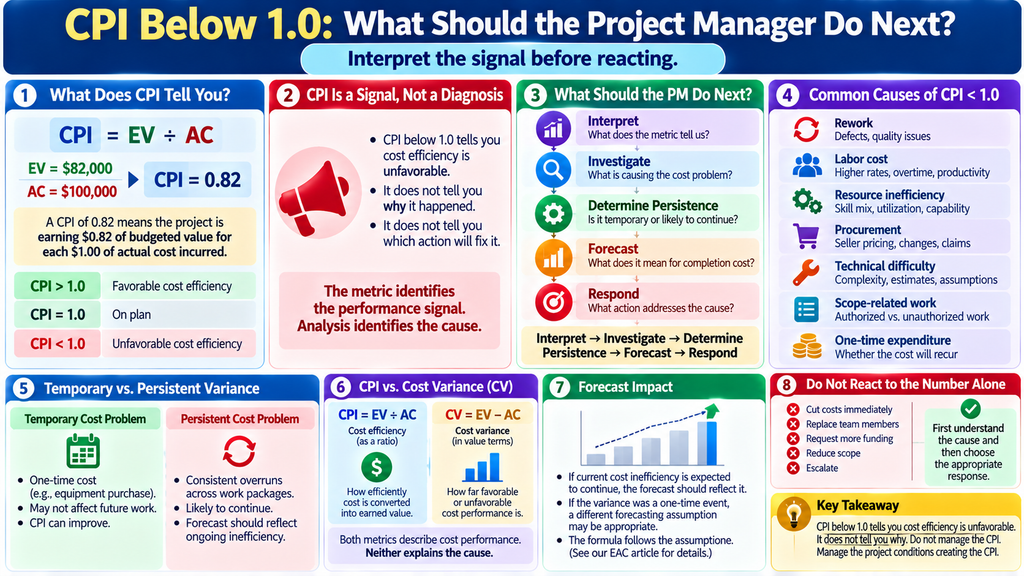
Interpret the signal before reacting.
A project reports:
CPI = 0.82
The sponsor is concerned about cost performance and asks the project manager to take action.
Should the PM:
- cut costs immediately,
- replace resources,
- request more funding,
- reduce scope,
- escalate?
Not yet.
A CPI below 1.0 tells the project manager something important.
But it does not tell the project manager why it happened or which response will fix it.
That creates the real PMP® reasoning question:
What does the CPI signal, what is causing it, and what should the PM do with that information?
A useful Project Reasoning Lab principle is:
Do not manage the CPI. Manage the project conditions creating the CPI.
1. Start With What CPI Actually Tells You
The Cost Performance Index (CPI) measures cost efficiency.
The formula is:
CPI = EV ÷ AC
Where:
- EV = Earned Value
- AC = Actual Cost
Suppose:
- EV = $82,000
- AC = $100,000
Then:
CPI = $82,000 ÷ $100,000 = 0.82
A CPI of 0.82 means the project is earning about $0.82 of budgeted value for each $1.00 of actual cost incurred.
The basic interpretation is:
- CPI > 1.0 → favorable cost efficiency
- CPI = 1.0 → cost efficiency is on plan
- CPI < 1.0 → unfavorable cost efficiency
So:
CPI below 1.0 tells you cost efficiency is unfavorable.
But that is the beginning of the analysis, not the end.
2. CPI Is a Signal — Not a Diagnosis
Suppose CPI is 0.82.
What caused it?
The metric alone does not tell you.
Possible causes may include:
- rework,
- higher-than-expected labor rates,
- overtime,
- low productivity,
- underestimated effort,
- technical difficulty,
- procurement cost increases,
- inefficient resource use,
- scope-related work,
- one-time expenditures.
So the PM should not jump directly from:
CPI < 1.0
to:
“Cut costs.”
The better reasoning is:
The metric identifies the performance signal. Analysis identifies the cause.
3. Use a Diagnosis-First Response Sequence
When CPI falls below 1.0, the PM should think in this order:
Interpret
What does the metric actually tell us?
Investigate
What is causing the unfavorable cost efficiency?
Determine Persistence
Is the condition temporary or likely to continue?
Forecast
What does the evidence suggest about total expected cost?
Respond
What action addresses the actual cause?
The reasoning sequence becomes:
Interpret → Investigate → Determine Persistence → Forecast → Respond
That is far stronger than reacting to the CPI value alone.
4. Investigate What Is Driving the Cost Problem
The PM should look behind the number.
For example:
| Possible Cause | What to Examine |
|---|---|
| Rework | Defects, quality issues, unclear requirements |
| Labor cost | Rates, overtime, productivity |
| Resource inefficiency | Skill mix, utilization, capability |
| Procurement | Seller pricing, changes, claims |
| Technical difficulty | Complexity, estimates, assumptions |
| Scope-related work | Authorized vs. unauthorized work |
| One-time expenditure | Whether the cost will recur |
The purpose is not to investigate everything indiscriminately.
It is to follow the evidence.
Investigate the cause that fits the performance pattern and project conditions.
5. Is the Variance Temporary or Persistent?
This distinction matters enormously.
Scenario A: Temporary Cost Problem
Suppose:
The project incurred a one-time specialized equipment cost that will not recur.
CPI may be unfavorable now.
But that does not automatically mean the same level of inefficiency will continue through the remaining work.
Scenario B: Persistent Cost Problem
Now suppose:
Multiple work packages consistently require 15% more labor than planned.
This suggests the cost inefficiency may continue.
The key question is:
Is the unfavorable CPI caused by an isolated event—or does it reflect a continuing performance pattern?
This distinction directly affects forecasting.
6. CPI and Cost Variance Are Related but Different
CPI is not the only cost-performance metric.
Cost Variance (CV) is:
CV = EV − AC
While CPI expresses cost efficiency as a ratio, CV expresses the difference in value terms.
For example:
- CPI tells you how efficiently cost is being converted into earned value.
- CV tells you how far favorable or unfavorable cost performance is in value terms.
Both describe cost performance.
Neither, by itself, explains the cause.
7. Then Assess the Forecast Impact
Once the PM understands the likely cause and whether it will continue, the next question is:
What does this mean for the expected cost at completion?
This is where the earlier BAC/EAC/ETC article becomes relevant.
If the current cost inefficiency is expected to continue, the forecast should reflect that.
If the unfavorable variance was caused by a one-time event and future work is expected to perform differently, the forecast should use that assumption instead.
The central principle is:
The forecast depends on what you believe about the remaining work — not merely on today's CPI.
And:
The formula follows the assumption.
There is no need to treat every CPI below 1.0 as an automatic BAC ÷ CPI situation.
8. CPI Below 1.0 Does Not Automatically Mean the Project Will Exceed BAC
A low CPI is unfavorable.
But it does not, by itself, prove exactly what the final project cost will be.
Why?
Because future performance may differ from past performance.
For example:
- corrective actions may improve efficiency,
- the original cause may not recur,
- remaining work may have a different cost profile,
- forecasts may change as better information becomes available.
So:
Current cost inefficiency is evidence for forecasting — not a complete forecast by itself.
9. Do Not Fix the Metric — Fix the Cause
Suppose CPI is poor because the project is experiencing significant rework.
The right response may involve:
- correcting quality problems,
- clarifying requirements,
- preventing additional defects.
Simply telling the team:
“Improve CPI.”
does not address the mechanism creating the unfavorable result.
Likewise:
If overtime is driving costs
Investigate workload, resource planning, and scheduling.
If seller changes are driving costs
Examine procurement and change-control issues.
If underestimated effort is the cause
Reassess remaining estimates and forecast implications.
The key principle is:
The response comes from the cause — not directly from the CPI value.
10. Do Not Cut Cost at the Expense of Required Outcomes
Suppose the project has an unfavorable CPI.
An immediate cost-cutting response could create new problems if it means:
- reducing required quality,
- removing necessary testing,
- ignoring compliance,
- under-resourcing critical work,
- creating greater future rework.
Cost control should not become indiscriminate cost reduction.
Improving cost performance does not mean sacrificing required project outcomes.
The PM should address inefficiency while preserving approved requirements and obligations.
11. CPI Does Not Decide Whether the Project Should Continue
A CPI below 1.0 evaluates cost performance.
It does not independently determine whether the project should be:
- continued,
- changed,
- paused,
- terminated.
Those decisions may depend on broader considerations such as:
- business value,
- strategic need,
- remaining cost,
- risk,
- compliance,
- organizational priorities.
So:
CPI is one decision input — not the entire project decision.
12. Scenario: One-Time Variance
Consider:
A project has CPI = 0.86 because an unexpected one-time certification cost was incurred. The certification is complete and will not recur.
The PM should not automatically assume CPI = 0.86 will continue for all remaining work.
Instead:
- confirm the cause,
- determine whether it will recur,
- update the forecast appropriately,
- monitor future performance.
The key is:
Understand whether today's inefficiency belongs to the past—or is likely to continue into the future.
13. Scenario: Persistent Inefficiency
Now consider:
CPI has remained between 0.80 and 0.85 for several reporting periods because activities consistently require more labor hours than estimated.
This looks less like a one-time event.
The PM should investigate:
- estimating assumptions,
- productivity,
- skill mix,
- complexity,
- rework,
- remaining work.
If the pattern is expected to continue, the cost forecast should reflect that evidence.
14. Scenario: Corrective Action Improves Performance
Suppose:
CPI was 0.82. After the team eliminates a major source of rework, cost performance improves over subsequent periods.
The improvement is useful evidence.
But the PM should still understand why it improved.
A stronger metric does not automatically prove which action caused the change.
So:
Interpret changes in CPI by understanding what changed in the work.
15. Project Reasoning Lab: Five-Question CPI Test
When a PMP scenario gives you CPI below 1.0, ask:
1. What does the metric tell me?
Cost efficiency is unfavorable.
2. What is causing it?
Look behind the number.
3. Is the cause temporary or persistent?
Determine whether current performance is likely to continue.
4. What does it mean for the forecast?
Assess expected completion cost based on the remaining work.
5. What response addresses the cause?
Act within the appropriate project and organizational authority.
The reasoning sequence is:
Interpret → Investigate → Determine Persistence → Forecast → Respond
16. Five Common PMP Traps
Trap 1: CPI < 1.0 = Cut Costs Immediately
No.
First identify the cause of the unfavorable efficiency.
Trap 2: CPI Tells You Why the Project Is Over Budget
No.
CPI measures cost efficiency.
It does not diagnose the cause.
Trap 3: CPI < 1.0 = Project Will Definitely Exceed BAC
Too absolute.
The completion forecast depends on remaining work and forecasting assumptions.
Trap 4: CPI < 1.0 = Always Use BAC ÷ CPI
No.
That approach assumes current cost efficiency will continue.
Trap 5: Improve the CPI
That is not a root-cause response.
Address the project condition producing the unfavorable CPI.
Final Takeaway
When CPI falls below 1.0, do not immediately:
- cut scope,
- replace people,
- request more money,
- escalate,
- or select a forecasting formula.
First ask:
What does the CPI actually tell me?
What is causing the unfavorable performance?
Is the cause temporary or persistent?
What does it mean for the forecast?
What action addresses the actual cause?
The central distinction is:
CPI below 1.0 tells you cost efficiency is unfavorable. It does not tell you why.
And the broader Project Reasoning Lab principle is:
Do not manage the CPI. Manage the project conditions creating the CPI.