PMP Exam Strategy
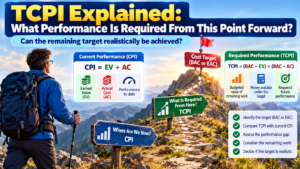
TCPI Explained: What Performance Is Required From This Point Forward?New!!
Learn how to interpret TCPI in PMP exam scenarios and determine the cost efficiency required to achieve BAC or EAC. Compare TCPI with current CPI, evaluate the performance gap, and decide whether the remaining cost target is realistically achievable.
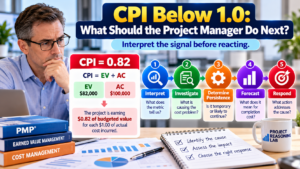
CPI Below 1.0: What Should the Project Manager Do Next?
Learn what CPI below 1.0 means in PMP exam scenarios and what the project manager should do next. Understand how to investigate the cause of unfavorable cost efficiency, distinguish temporary from persistent variance, assess forecast impact, and choose a response based on the underlying project condition.
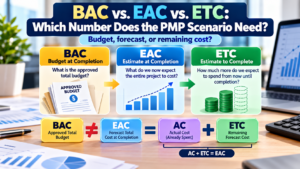
BAC vs. EAC vs. ETC: Which Number Does the PMP Scenario Need?
Learn how to distinguish BAC, EAC, and ETC in PMP exam scenarios. Understand the difference between the approved budget, the current total cost forecast, and the remaining expected cost—and how to identify the right metric before choosing a formula.
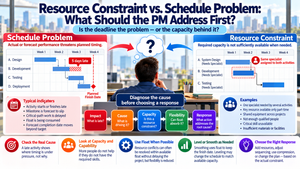
Resource Constraint vs. Schedule Problem: What Should the PM Address First?
Learn how to distinguish a resource constraint from a schedule problem in PMP exam scenarios. Understand how capacity, capability, float, resource leveling, and resource smoothing help determine what is actually driving schedule pressure—and what the project manager should address first.
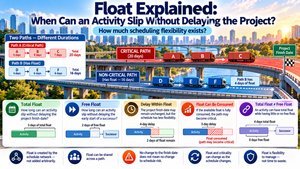
Float Explained: When Can an Activity Slip Without Delaying the Project?
Learn how float works in PMP exam scenarios, including the difference between total float and free float. Understand how delays consume schedule flexibility, affect successor activities and the project finish date, and can cause a non-critical path to become critical.
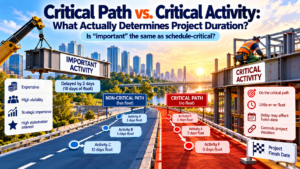
Critical Path vs. Critical Activity: What Actually Determines Project Duration?
Learn the difference between an important activity and a schedule-critical activity in PMP exam scenarios. Understand how the critical path, float, dependencies, and schedule network determine project duration — and why an activity can be expensive, visible, or high-risk without controlling the project finish date.
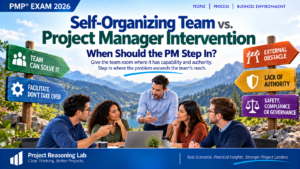
Self-Organizing Team vs. Project Manager Intervention: When Should the PM Step In?
Learn when a project manager should empower a self-organizing team—and when intervention is necessary. Use four practical questions to determine whether the team can solve the problem, has the authority to act, faces an external obstacle, or needs support with governance and compliance.
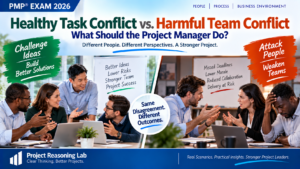
Healthy Task Conflict vs. Harmful Team Conflict: What Should the Project Manager Do?
Learn how to distinguish healthy task conflict from harmful team conflict in PMP exam scenarios. Discover when disagreement can improve decisions, when it begins damaging collaboration and performance, and how the project manager should respond.
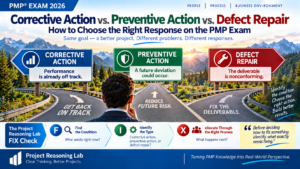
Corrective Action vs. Preventive Action vs. Defect Repair: How to Choose the Right Response on the PMP Exam
Learn how to distinguish corrective action, preventive action, and defect repair in PMP exam scenarios. Use the Project Reasoning Lab FIX Check to identify what is wrong, determine the appropriate response, and choose what should happen next.
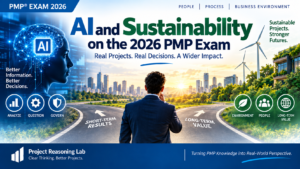
AI and Sustainability on the 2026 PMP Exam: What Project Managers Need to Understand
Learn how AI and sustainability appear in 2026 PMP exam scenarios and what project managers need to consider before making a decision. Explore data quality, assumptions, governance, stakeholder impact, lifecycle value, and long-term risk using the Project Reasoning Lab IMPACT Check.