Corrective Action vs. Preventive Action vs. Defect Repair: How to Choose the Right Response on the PMP Exam
 admino
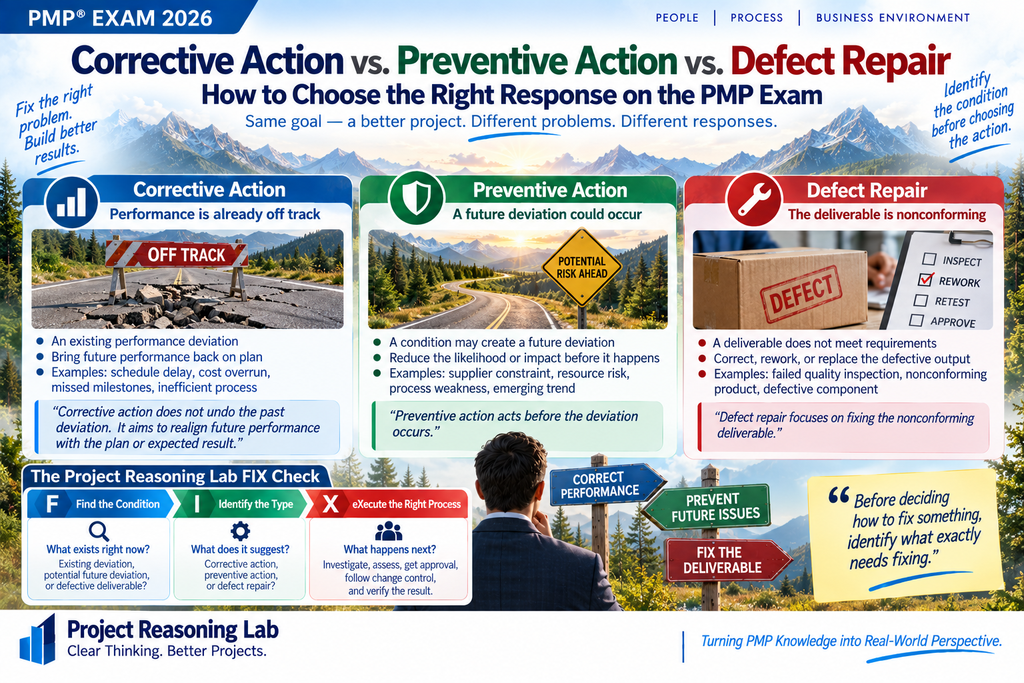
Three answer choices can all sound like:
“Fix the problem.”
But they may be solving very different problems.
A PMP® scenario may describe:
- a project that is already deviating from plan,
- a condition that could cause a future deviation,
- or a deliverable that does not meet requirements.
The key is to identify what exactly is wrong right now.
A useful starting point is:
Corrective action → existing performance deviation
Preventive action → potential future deviation
Defect repair → nonconforming deliverable
The challenge is not memorizing those labels.
It is recognizing which condition the scenario is actually describing.
1. Start With the Condition
Before choosing an answer, ask:
Is project performance already off track?
Is there evidence that performance could deviate in the future?
Or does the deliverable itself fail to meet requirements?
Those three conditions point in different directions.
Corrective Action
Think:
Something is already off plan.
The goal is to adjust the work or process so that future performance moves back toward the expected result.
Examples may include:
- recurring schedule slippage,
- unfavorable cost performance,
- missed performance targets,
- inefficient processes.
Preventive Action
Think:
A condition exists that may create a future deviation.
The goal is to reduce the likelihood or impact of that future problem before it affects performance.
Defect Repair
Think:
The output itself is nonconforming.
The goal is to correct, rework, or replace the defective deliverable so it meets requirements.
2. Corrective Action: Performance Is Already Off Track
Consider:
The project has missed three consecutive internal milestones because approval handoffs repeatedly take longer than planned.
The deviation already exists.
The project manager may need a corrective action such as:
- redesigning the approval workflow,
- removing a recurring bottleneck,
- changing the work approach,
- reallocating resources.
The important point is:
Corrective action does not undo the past deviation. It aims to realign future performance with the plan or expected result.
3. Preventive Action: The Deviation Has Not Happened Yet
Now consider:
A supplier has not missed any deliveries, but new information shows that its production capacity may become constrained next month.
The project has not yet experienced a delay.
But evidence suggests future performance could be affected.
A preventive action might include:
- securing backup capacity,
- changing the sequence of work,
- qualifying another source,
- preparing an alternative resource.
The purpose is to act before the deviation occurs.
4. Defect Repair: The Deliverable Is the Problem
Now consider:
During testing, a software module fails an approved performance requirement.
The problem is not simply that the project is behind schedule or at risk of a future deviation.
The output itself does not meet requirements.
That points toward defect repair.
The response may involve:
- correction,
- rework,
- replacement,
- retesting,
- verification.
The focus is:
Fix the nonconforming deliverable.
5. Three Similar Situations, Three Different Responses
Consider these scenarios.
Scenario A
The project is consistently exceeding planned cost because of inefficient rework.
The deviation already exists.
Think:
Corrective action
Scenario B
Analysis shows that a new supplier constraint may cause future cost overruns.
The overrun has not yet happened.
Think:
Preventive action
Scenario C
A completed component fails inspection and does not meet the approved specification.
The output itself is defective.
Think:
Defect repair
All three situations involve something undesirable.
But they are not the same type of problem.
6. One Scenario Can Require More Than One Response Type
The categories can interact.
Suppose:
A team repeatedly produces defective components because its inspection process is weak.
There may be two separate needs.
Immediate need
Repair the defective components.
→ Defect repair
Broader need
Improve the weak process that keeps producing defects.
→ Corrective action
This distinction matters:
Repairing the current defect does not necessarily correct the process that caused it.
And if the team identifies a weakness that has not yet caused a deviation, a preventive action may also be appropriate.
7. Preventive Action vs. Risk Response
These concepts can overlap, so avoid turning them into rigid categories.
A risk response is tied to managing an identified uncertainty.
A preventive action aims to avoid or reduce a future performance deviation.
Depending on the scenario, the same management action may serve both purposes.
For example:
A supplier may become unavailable next quarter.
If the project team treats this as a specific uncertainty and develops a response, that is risk management.
If the project manager changes sourcing arrangements to reduce the chance of future performance disruption, the action can also function preventively.
The better question is not:
“Which label sounds right?”
It is:
“What condition is being managed, and what is the purpose of the response?”
8. The Category Does Not Tell You the Whole Response
Classifying the situation is only the first step.
Consider:
A recurring defect is caused by inadequate training.
Several actions may be needed.
Repair the defective item
→ Defect repair
Improve the team’s performance through training
→ Corrective action
Introduce an additional control to reduce the chance of future recurrence
→ Preventive action
One scenario can therefore contain multiple response types.
The PMP question may be testing:
- the immediate response,
- the underlying cause,
- the required change,
- the authority to act,
- or what should happen next.
Do not stop at the label.
9. Scenario: Performance Is Already Off Track
Consider:
The project is four weeks behind schedule because approval handoffs are repeatedly taking longer than planned.
Two possible answers remain:
A. Redesign the approval workflow to reduce recurring delay.
B. Develop a response for a possible future supplier delay.
The project already has an active schedule-performance problem.
Option A addresses the existing deviation.
That is corrective-action reasoning.
10. Scenario: A Future Deviation Is Becoming More Likely
Consider:
A key specialist has not left the project, but the manager learns that the specialist may be reassigned next month.
The problem has not yet occurred.
A preventive action might include:
- cross-training another team member,
- documenting critical knowledge,
- preparing a backup resource.
The purpose is to reduce the impact before the possible deviation occurs.
11. Scenario: The Deliverable Fails Inspection
Consider:
A manufactured component is completed but fails the approved tolerance requirement.
The immediate problem is clear:
The deliverable is defective.
The response is likely to involve:
- rework,
- correction,
- replacement,
- retesting,
depending on the situation.
That is defect repair.
12. The Project Reasoning Lab FIX Check
When corrective action, preventive action, or defect repair appear in a PMP scenario, use the FIX Check.
F — Find the Condition
Ask:
What exists right now?
Is it:
- an existing performance deviation,
- a potential future deviation,
- a defective deliverable?
Do not choose the response before identifying the condition.
I — Identify the Type
Ask:
What kind of response does this condition suggest?
Existing performance deviation
Think:
Corrective action
Potential future deviation
Think:
Preventive action
Nonconforming deliverable
Think:
Defect repair
X — eXecute Through the Right Process
Then ask:
What response is actually appropriate, and what process or authority applies?
The project manager may still need to:
- investigate the cause,
- assess impact,
- obtain approval,
- follow change control,
- assign responsibility,
- verify the result.
Classification helps.
It does not replace judgment.
13. Quick Comparison
| Situation | Primary Focus | Likely Response Type |
|---|---|---|
| Project is already off plan | Realign future performance | Corrective action |
| Condition may cause a future deviation | Reduce future deviation | Preventive action |
| Deliverable does not meet requirements | Correct the output | Defect repair |
| Recurring defects reveal process weakness | Fix output and underlying performance | Defect repair + corrective action |
| Weakness identified before failure occurs | Prevent future performance problem | Preventive action |
This is a reasoning guide, not an automatic answer key.
14. Three Common Traps
Everything Wrong = Corrective Action
Not necessarily.
A defective deliverable points more directly toward defect repair.
Future Problem = Corrective Action
If the deviation has not happened yet, preventive action may fit better.
Fixing the Product = Fixing the Process
Repairing one defective item does not automatically correct the process that created it.
Final Takeaway
Corrective action, preventive action, and defect repair all involve improvement.
But they address different conditions.
Ask:
Is performance already off track?
→ Corrective action
Could a future deviation occur?
→ Preventive action
Does the deliverable fail to meet requirements?
→ Defect repair
Then go one step further.
Ask:
What caused the condition?
What response is actually appropriate?
What process, authority, or approval applies?
Before deciding how to fix something, identify what exactly needs fixing.
That is the distinction the PMP scenario is really testing.