MVP vs. Prototype vs. Increment: What Is Being Delivered?
 admino
Learning, validation, or usable value?
A financial services organization is developing a digital customer onboarding platform using Scrum within a hybrid project.
The objective is to allow customers to verify their identities remotely without visiting a branch.
During development, three different activities take place.
First, the UX team creates an interactive mock-up demonstrating how customers might upload identification documents.
Second, Developers complete a secure document-upload capability that meets the Definition of Done.
Third, the Product Owner proposes a limited customer experiment to determine whether digital onboarding is valuable enough to justify further investment.
At a project review, a senior stakeholder asks:
“We have a prototype, an Increment, and a proposed MVP. Aren't they all just different versions of the same product?”
What should the project manager explain?
All three concepts may involve something tangible, testable, or demonstrable. However, they serve different purposes and provide different kinds of evidence.
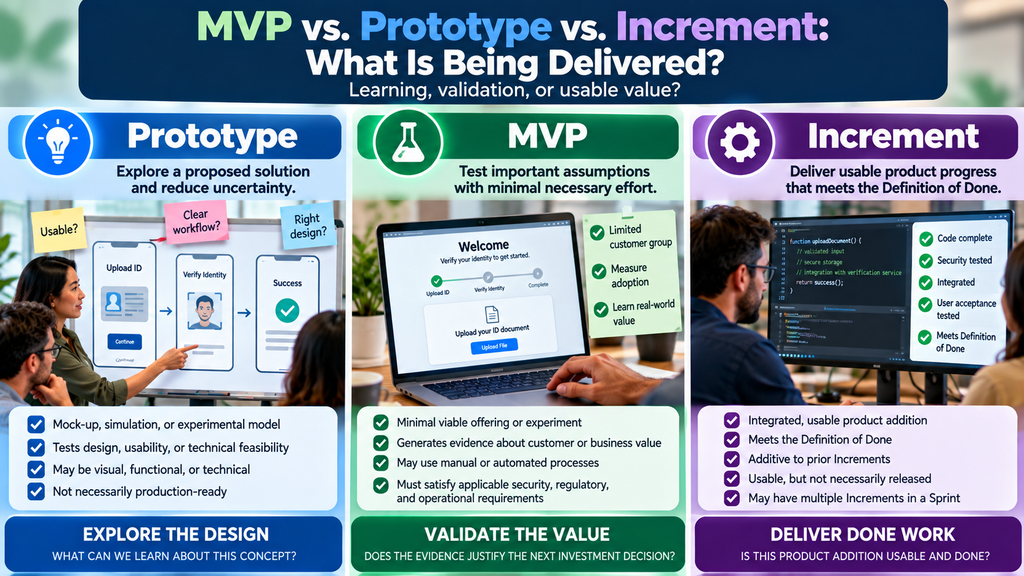
A prototype helps explore uncertainty. An MVP generates evidence about important product or business assumptions. A Scrum Increment represents usable product progress that meets the Definition of Done.
For PMP® candidates, the central question is not simply what has been built.
It is what the organization needs to learn, validate, or deliver—and what decision should follow.
1. MVP vs. Prototype vs. Increment: The Fundamental Difference
These concepts are related, but they are not interchangeable.
| Dimension | Prototype | MVP | Scrum Increment |
|---|---|---|---|
| Primary purpose | Explore a proposed solution and reduce uncertainty | Test important assumptions with minimal necessary effort | Deliver usable product progress |
| Central question | What can we learn about this concept? | Does the evidence justify the next investment decision? | Is this product addition usable and Done? |
| Typical form | Mock-up, simulation, experimental model | Minimal viable offering or experiment | Integrated, usable product addition |
| Main audience | Users, designers, technical specialists, stakeholders | Target users, customers, business decision-makers | Scrum Team and relevant stakeholders |
| Quality expectation | Appropriate to the experiment | Appropriate to safe, meaningful validation | Must meet the Definition of Done |
| Production readiness | Not necessarily | Depends on the experiment | Usable, but not necessarily released |
| Primary evidence | Design, interaction, feasibility | Behaviour, adoption, value, viability | Verified product progress |
| PMP interpretation | Reduce uncertainty | Support evidence-based decisions | Inspect usable outcomes and adapt |
These are not necessarily three sequential stages.
An MVP may contain several Done Increments. A prototype may support an MVP experiment. One Increment may provide enough functionality to enable meaningful customer validation.
Their activities can overlap, but their purposes remain distinct.
2. What Is a Prototype?
A prototype is a model or experimental version of a proposed product, feature, process, or solution.
Its primary purpose is to explore uncertainty before committing significant resources.
Prototypes can take different forms.
Low-Fidelity Prototype
A low-fidelity prototype may consist of sketches, wireframes, or simplified screen layouts.
For the onboarding platform, the UX team might create a series of screens showing how customers select and upload identification documents.
The team can explore whether customers understand the proposed workflow.
High-Fidelity Prototype
A high-fidelity prototype may include interactive screens, realistic graphics, and simulated functionality.
Customers can navigate the onboarding process and provide usability feedback.
However, the prototype may not actually verify identities or securely store documents.
Functional or Technical Prototype
A prototype may also test how a particular technology or solution behaves.
For example, Developers might build an experimental integration with an identity-verification service.
A related concept is a proof of concept, which primarily tests whether an approach is feasible.
Prototypes and proofs of concept can overlap, but they are not identical.
What Does a Prototype Prove?
A prototype may provide evidence about usability, technical feasibility, performance, or design assumptions.
It does not automatically establish that a product is operationally ready.
A convincing demonstration may answer:
“Can customers understand this interface?”
It may not answer:
“Can customers safely complete identity verification using this solution?”
PMP principle: A prototype reduces uncertainty, but its appearance does not establish production readiness.
3. What Is a Minimum Viable Product (MVP)?
A Minimum Viable Product is a minimal offering or experiment designed to generate meaningful evidence about key customer or business assumptions with the least necessary effort.
Its purpose is not merely to deliver fewer features.
It supports a better decision before committing additional resources.
Start With a Hypothesis
Suppose the bank believes customers will prefer completing onboarding remotely rather than visiting a branch.
The hypothesis might be:
“Eligible customers will successfully complete digital onboarding and prefer it to the existing branch-based process.”
The MVP experiment should generate evidence relevant to that assumption.
Minimize Effort, Not Essential Quality
An MVP does not always require a fully automated version of the intended product.
The bank might combine a secure digital document-upload capability with an approved manual identity-verification process.
This limited offering could allow eligible customers to complete onboarding while the organization measures demand and usability.
However, the experiment must still satisfy applicable privacy, security, regulatory, and operational requirements.
Minimum does not mean unsafe, unreliable, or misleading.
Measure Meaningful Outcomes
The organization might evaluate:
- Onboarding completion rate.
- Customer adoption.
- Abandonment rate.
- Time required to complete onboarding.
- Customer satisfaction.
- Support requests.
These measures help determine whether the offering provides sufficient value to justify further investment.
What If the Hypothesis Is Wrong?
Suppose the bank expects 70% of eligible customers to complete digital onboarding, but only 35% do so.
The commercial result may be disappointing.
However, the experiment may still provide valuable evidence about customer behaviour, technical barriers, or unmet needs.
An MVP experiment can support, contradict, or fail to resolve the original hypothesis.
A successful learning experiment does not necessarily mean the product should be expanded.
Its value lies in producing credible evidence for a better decision.
PMP principle: An MVP is defined by its learning purpose and viability—not simply by having the fewest features.
4. What Is a Scrum Increment?
In Scrum, an Increment is a concrete stepping stone toward the Product Goal.
Each Increment is additive to prior Increments, thoroughly verified, and must work together with the existing product.
Work cannot be considered part of an Increment unless it meets the Definition of Done.
The Definition of Done
The Definition of Done formally describes the state of the Increment when it meets the quality measures required for the product.
It is the commitment associated with the Increment and creates transparency about completed work.
For the onboarding platform, applicable quality measures may include integration, security verification, functional testing, and documentation.
If organizational standards establish a minimum Definition of Done, Scrum Teams must follow that minimum.
When multiple Scrum Teams work on the same product, they must mutually define and comply with the same Definition of Done.
Can a Sprint Produce Multiple Increments?
Yes.
Multiple Increments may be created within a Sprint.
An Increment may also be delivered to stakeholders before the Sprint ends.
Increment vs. Release
A Done Increment does not automatically have to be publicly released.
The Sprint Review is not a release gate.
Release decisions may involve timing, operational arrangements, customer communication, contractual obligations, or regulatory controls.
However, these considerations must not be used to disguise incomplete work.
If essential security verification belongs in the Definition of Done, work that has not passed that verification cannot be represented as Done.
PMP principle: An Increment demonstrates usable, integrated product progress that meets the Definition of Done—not necessarily a public release.
5. Prototype vs. MVP: What Is the Team Trying to Learn?
A prototype and an MVP can both support learning.
The difference is the uncertainty being investigated.
Prototype Example
Customers interact with a simulated onboarding interface.
Several participants cannot locate the identity-upload button.
The team learns that the design needs improvement.
This provides useful usability evidence.
However, the organization still does not know whether customers will adopt the operational onboarding service.
MVP Example
The bank offers a limited but viable onboarding experience to eligible customers.
The organization measures completion rates, abandonment, satisfaction, and support needs.
This provides evidence about customer behaviour and the value of the proposed service.
The Important Distinction
A prototype can be functional and may contribute to an MVP experiment.
An MVP may use prototypes, manual processes, or completed software capabilities.
The distinction is therefore not simply whether the result is functional.
A prototype primarily explores a proposed solution. An MVP primarily tests assumptions that influence product or investment decisions.
6. MVP vs. Increment: Why Done Does Not Automatically Mean Validated
This is one of the most important distinctions for PMP candidates.
A Scrum Increment and an MVP may involve the same product capabilities, but they operate at different levels.
An Increment Demonstrates Done Product Progress
Suppose Developers complete a secure document-upload capability.
It is integrated, verified, usable, and meets the Definition of Done.
This represents an Increment.
However, customers may still be unable to complete onboarding.
The capability alone may not provide sufficient functionality to test the bank’s adoption hypothesis.
An MVP Supports a Meaningful Experiment
The bank may combine secure upload, customer notifications, and an approved manual verification process.
Together, these may provide a viable experience for testing whether customers will adopt remote onboarding.
The organization can then gather evidence before investing in full automation.
Can an MVP Contain Multiple Increments?
Yes.
Several Done Increments may collectively enable an MVP experiment.
Can One Increment Support an MVP?
Yes.
If one Done Increment provides enough viable functionality for the intended experiment, it may support an MVP.
Does Every Increment Qualify as an MVP?
No.
A Done Increment demonstrates usable product progress.
It does not automatically establish that the organization can test its intended business hypothesis.
Does Every MVP Require Scrum?
No.
MVP is a product-development and learning concept that can be used with different delivery approaches.
A Scrum Increment is a defined Scrum concept.
Key lesson: An MVP is defined primarily by viability and learning objectives; a Scrum Increment is defined by usable product progress meeting the Definition of Done.
7. MVP vs. Pilot: Are They the Same Thing?
An MVP and a pilot are related but different concepts.
An MVP emphasizes learning about important product or business assumptions.
A pilot emphasizes testing a solution in a limited real-world setting.
| MVP | Pilot |
|---|---|
| Focuses on validating important assumptions | Focuses on limited deployment or operational testing |
| Defined primarily by learning objectives | Defined primarily by controlled implementation conditions |
| May use manual or automated processes | May involve selected users, locations, or departments |
| Can be evaluated through a pilot | Can evaluate an MVP or a more complete solution |
For example, the bank might conduct a controlled pilot with 100 eligible customers to evaluate its MVP.
However, a pilot of an established product is not automatically an MVP.
PMP principle: An MVP describes what the organization needs to learn; a pilot describes one way the solution may be tested in practice.
8. Prototype vs. Increment: Demonstration Is Not the Same as Done
Consider a Sprint Review.
A team demonstrates a realistic identity-verification interface.
Stakeholders are impressed.
However, the interface has not been integrated with the existing product or completed required security verification.
It should not be presented as a Done Increment merely because the demonstration is convincing.
The team may still use the prototype to obtain feedback, provided its status is transparent.
Now consider another result.
Developers complete a document-validation capability that meets the Definition of Done.
It may not look impressive, but it represents verified, usable product progress.
PMP principle: Judge the result against its intended purpose and completion criteria—not how finished it appears.
9. Three Deliverables, One Product Journey
Return to the digital onboarding platform.
Prototype — Explore the Design
The UX team develops an interactive mock-up.
Customers test the interface, and the team identifies confusing design elements.
Evidence: Usability feedback.
Done Increments — Deliver Usable Capabilities
Developers build secure document upload, customer notifications, and supporting verification capabilities.
Each completed addition meets the Definition of Done and works with the existing product.
Evidence: Verified product progress.
MVP — Test Customer Value
The organization combines the right capabilities into a limited, viable onboarding offering.
It measures whether customers complete onboarding and whether the approach justifies further investment.
Evidence: Real-world behaviour and business outcomes.
This is one possible journey, not a mandatory sequence.
Prototyping, Increment creation, and MVP experiments may overlap.
The appropriate approach depends on the uncertainty the organization needs to address.
10. Project Reasoning Lab: The Five-Question Delivery Purpose Test
When a PMP scenario describes a demonstration, experiment, pilot, or completed feature, use the following framework.
1. Purpose
What uncertainty or delivery objective is being addressed?
Is the team exploring a design, validating value, or delivering usable product progress?
2. Evidence
What must the team demonstrate or learn?
Does the decision require usability feedback, customer behaviour, technical feasibility, or verified completion?
3. Usability
Is the result a simulation, a viable offering, or a Done product addition?
Determine what the result can actually do and which quality requirements apply.
4. Audience
Who will evaluate or use the result, and under what conditions?
A usability participant, pilot customer, and Sprint Review stakeholder may provide different evidence.
5. Decision
What should happen after the team inspects the result?
The team may revise a design, expand an experiment, adapt the Product Backlog, release value, or reconsider investment.
Remember the Sequence
Purpose → Evidence → Usability → Audience → Decision
This is a Project Reasoning Lab study framework, not an official PMI or Scrum procedure.
11. Four Practical PMP Scenarios
Scenario A — A Prototype Looks Finished
A stakeholder sees an interactive mock-up and asks to release it immediately.
Best response: Clarify that the prototype demonstrates interaction but does not necessarily satisfy operational, security, or release requirements.
Tests: Prototype purpose versus production readiness.
Scenario B — Leadership Wants to Test Customer Adoption
The organization wants to determine whether customers will use digital onboarding before funding full automation.
Best response: Design a viable MVP experiment, establish success measures, and use approved capabilities or manual processes where appropriate.
Tests: Hypothesis validation and value-based investment.
Scenario C — Developers Complete a Feature
Developers finish an integrated document-upload capability that meets the Definition of Done.
It has not been publicly released.
Best response: Recognize it as a Done Increment while distinguishing completion from the release decision.
Tests: Definition of Done and Increment versus release.
Scenario D — An Experiment Challenges the Business Case
The bank’s MVP experiment produces much lower customer adoption than expected.
Best response: Examine the evidence, identify potential causes, and collaborate with the Product Owner and stakeholders before deciding whether to adapt, repeat, expand, or discontinue the initiative.
Tests: Make evidence-based decisions rather than assuming every experiment must confirm its hypothesis.
12. Advanced PMP Scenario Challenge: Two Plausible Answers
A hybrid financial services project is developing a digital onboarding platform.
The Scrum Team has delivered Done Increments for secure document upload and automated customer notifications.
Leadership wants evidence of customer adoption before approving additional investment.
The current solution does not support a completely automated onboarding process, but a compliant manual verification process is available.
What should the project manager recommend next?
A. Collaborate with the Product Owner and stakeholders to design a limited MVP experiment combining Done capabilities with the approved manual verification process, establish measurable success criteria, and assess customer behaviour.
B. Collaborate with the Product Owner to prioritize the remaining automated verification features so the team can deliver a complete end-to-end Increment before beginning customer validation.
C. Recommend a high-fidelity prototype of the complete automated onboarding journey to validate usability before committing to additional development.
D. Release the completed Increments to a selected customer group and use their feedback to determine whether the product is ready for broader adoption.
Correct Answer: A
Option A directly addresses the organization’s need for customer-adoption evidence while minimizing unnecessary development.
It also respects the Product Owner’s accountability for product value and incorporates the available compliant verification process.
Why B Is Plausible but Not Best
A complete automated workflow could support customer validation.
However, building the remaining features first may require unnecessary investment before testing the central business hypothesis.
Why C Is Plausible but Not Best
A high-fidelity prototype could reveal usability problems.
However, it would not directly measure whether customers adopt and complete the operational onboarding service.
Why D Is Plausible but Not Best
The completed capabilities meet the Definition of Done.
However, releasing them without a viable end-to-end experience may not provide meaningful evidence about onboarding adoption.
The Deeper PMP Lesson
The best deliverable is not necessarily the most technically complete or visually impressive result.
It is the result that provides the evidence needed for the next responsible decision.
13. Five Common PMP Traps
| Trap | Better Reasoning |
|---|---|
| A prototype looks real, so it is ready for release | Appearance does not establish operational readiness |
| MVP means minimum quality | Minimum scope does not mean inadequate safety or quality |
| Every Sprint produces exactly one Increment | Multiple Increments may be created during a Sprint |
| Every Done Increment is automatically released | Completion and release are distinct decisions |
| MVP, prototype, and Increment are sequential stages | They may overlap and serve different purposes |
The central mistake is assuming that these concepts represent different degrees of product completeness.
They are better understood through their purpose, evidence, and completion expectations.
14. Predictive, Agile, and Hybrid: How Are These Concepts Used?
Predictive Projects
Prototypes may reduce design or technical uncertainty before major commitments.
Incremental delivery may also be appropriate when the delivery strategy supports it, although a Scrum Increment has a specific meaning within Scrum.
Agile Projects
Prototypes support discovery, MVPs support value validation, and Done Increments provide usable product progress.
These activities reinforce one another through feedback and adaptation.
Hybrid Projects
A team may use Scrum to build Increments while the organization applies formal controls to funding, compliance, customer pilots, or external releases.
The project manager should recognize which decisions concern product discovery, which concern Scrum delivery, and which require organizational governance.
PMP principle: Tailor the deliverable and validation approach to uncertainty, required evidence, and organizational constraints.
15. Final Takeaway: What Is the Team Actually Trying to Prove?
Return to the onboarding platform.
The interactive mock-up helps the organization learn whether customers understand the proposed design.
The Done document-upload capability demonstrates usable product progress.
The MVP experiment tests whether a minimal viable onboarding offering creates sufficient customer and business value.
The distinction is straightforward:
A prototype helps explore uncertainty. An MVP generates evidence for a product or investment decision. A Scrum Increment demonstrates usable product progress that meets the Definition of Done.
For PMP scenarios, remember:
Purpose → Evidence → Usability → Audience → Decision
And apply one final principle:
Do not confuse something that looks convincing, something that generates learning, and something that is Done. Each provides different evidence—and supports a different decision.
Clear Thinking. Better Projects.