
Fast Tracking vs. Crashing: Which Schedule Compression Technique Fits?
Learn how to choose between fast tracking and crashing in PMP exam scenarios. Understand how the critical path, activity dependencies, resource availability, cost, and risk determine which schedule compression technique fits — and why shortening an activity does not always shorten the project.
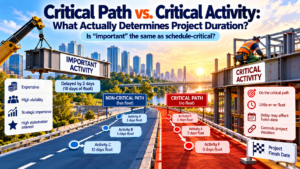
Critical Path vs. Critical Activity: What Actually Determines Project Duration?
Learn the difference between an important activity and a schedule-critical activity in PMP exam scenarios. Understand how the critical path, float, dependencies, and schedule network determine project duration — and why an activity can be expensive, visible, or high-risk without controlling the project finish date.

Schedule Variance vs. Schedule Forecast: What Is the Difference?
Learn the difference between schedule variance and schedule forecasting in PMP exam scenarios. Understand what SV and SPI reveal about current earned-value performance, why they do not directly predict the project completion date, and how critical path, remaining work, dependencies, and risk shape the schedule forecast.
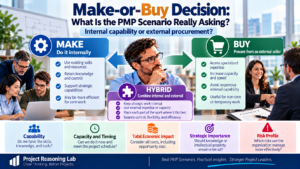
Make-or-Buy Decision: What Is the PMP Scenario Really Asking?
Make-or-Buy Decision: What Is the PMP Scenario Really Asking? A project needs a product, service, or capability. Should the organization: At first glance, this can look like a cost question. It is broader than that. A make-or-buy decision is really about: A useful Project Reasoning Lab principle is: Make-or-buy asks where the work should live […]
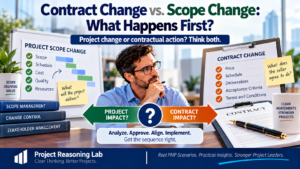
Contract Change vs. Scope Change: What Happens First?
Learn how to distinguish a project scope change from a contract change in PMP exam scenarios. Understand when to assess project and seller impacts, when contractual modification may be required, who has authority to approve each change, and what should happen before changed seller work begins.
Fixed-Price vs. Cost-Reimbursable vs. Time-and-Materials: How PMP Scenarios Test Contract Choice
Learn how to choose between fixed-price, cost-reimbursable, and time-and-materials contracts in PMP exam scenarios. Understand how scope certainty, cost uncertainty, flexibility, and risk allocation determine which contract structure best fits the situation.

Seller Delay vs. Contract Performance Problem: What Should the Project Manager Do?
A seller misses a delivery date. Is that automatically a contract-performance failure? Not necessarily. A late delivery may result from: That is why procurement scenarios on the PMP® exam can be deceptively difficult. The visible symptom may be: “The seller is late.” But the better question is: What was actually required, who controlled the cause, […]

Self-Organizing Team vs. Project Manager Intervention: When Should the PM Step In?
Learn when a project manager should empower a self-organizing team—and when intervention is necessary. Use four practical questions to determine whether the team can solve the problem, has the authority to act, faces an external obstacle, or needs support with governance and compliance.

Coaching vs. Training vs. Mentoring: What Does the Team Member Actually Need?
A team member is struggling. Should the project manager: On the PMP® exam, several of those answers can sound supportive. But they solve different problems. The better question is not: “How can I help this person?” It is: “What is actually preventing this person from succeeding?” A performance problem does not automatically mean a development […]

Healthy Task Conflict vs. Harmful Team Conflict: What Should the Project Manager Do?
Learn how to distinguish healthy task conflict from harmful team conflict in PMP exam scenarios. Discover when disagreement can improve decisions, when it begins damaging collaboration and performance, and how the project manager should respond.