Coaching vs. Training vs. Mentoring: What Does the Team Member Actually Need?
 admino
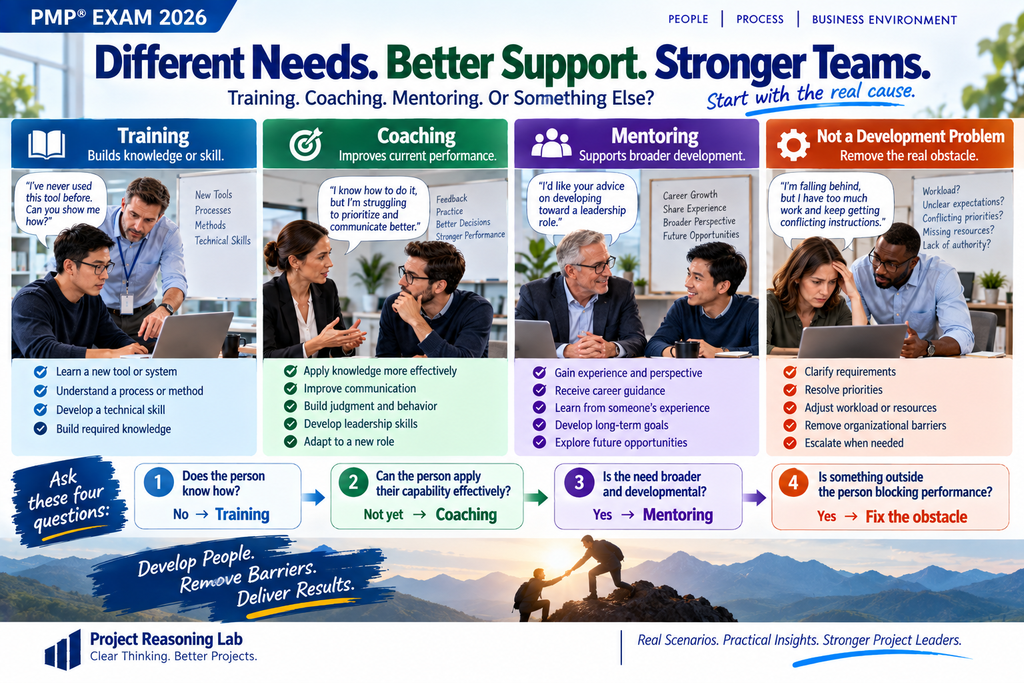
A team member is struggling.
Should the project manager:
- provide training,
- coach the person,
- connect them with a mentor,
- clarify expectations,
- or remove an obstacle?
On the PMP® exam, several of those answers can sound supportive.
But they solve different problems.
The better question is not:
“How can I help this person?”
It is:
“What is actually preventing this person from succeeding?”
A performance problem does not automatically mean a development problem.
Sometimes the person lacks a skill.
Sometimes they need help applying what they already know.
Sometimes they want broader professional guidance.
And sometimes the real problem is not the person at all.
1. Start With Four Diagnostic Questions
Before choosing coaching, training, or mentoring, ask four questions.
1. Does the person know how?
If the person lacks specific knowledge or skill:
→ Think training
2. Can the person apply their capability effectively?
If the person has the knowledge but needs help improving performance, judgment, behavior, or application:
→ Think coaching
3. Is the need broader and developmental?
If the person wants perspective, guidance, or longer-term professional growth:
→ Think mentoring
4. Is something outside the person blocking performance?
If the problem is:
- workload,
- unclear expectations,
- conflicting priorities,
- missing resources,
- organizational barriers,
then the solution may not be development at all.
Before developing the person, determine whether the person is actually the constraint.
2. Training Builds Knowledge or Skill
Training is most appropriate when someone needs to learn how to perform a task or use a capability.
Examples may include:
- learning a new software tool,
- understanding a new process,
- developing a technical skill,
- learning a required methodology,
- becoming familiar with a new system.
Consider:
A team member is assigned to use an analysis platform they have never used before.
The problem is straightforward.
The person does not yet know how to perform the required work.
Training may be appropriate.
The key question is:
Is knowledge or skill missing?
If yes, training is a strong possibility.
3. Coaching Helps Improve Current Performance
Coaching is different.
The person may already have the necessary knowledge and capability.
But they may need help improving how they apply it in a current role or challenge.
Coaching can support:
- performance,
- judgment,
- communication,
- leadership behavior,
- prioritization,
- decision-making,
- self-awareness,
- adaptation to a new responsibility.
Consider:
A team member has successfully completed similar assignments before but now struggles to prioritize work and communicate blockers.
Another technical course may not solve the problem.
The project manager may instead:
- discuss the performance pattern,
- provide feedback,
- ask questions,
- agree on improvement goals,
- help the person develop a better approach.
A useful distinction is:
Training builds knowledge or skill. Coaching helps improve performance, judgment, or behavior in a current challenge.
4. Mentoring Supports Broader Development
Mentoring usually serves a broader purpose.
Consider:
A junior project professional performs well and asks an experienced leader for guidance about developing toward future project-management responsibilities.
There may be no performance problem at all.
The person may benefit from:
- experience-based advice,
- professional perspective,
- career guidance,
- lessons learned,
- broader development.
Mentoring tends to look beyond one immediate assignment.
A simple distinction is:
Training → learn something
Coaching → improve how you perform now
Mentoring → develop more broadly over time
These are useful distinctions, not rigid boundaries.
5. Scenario: The Person Lacks a Technical Skill
Consider:
A team member is assigned responsibility for a new analysis tool but does not know how to use it.
Two possible responses are:
A. Coach the person on improving motivation.
B. Arrange appropriate training or skill development.
The immediate problem is a capability gap.
Option B addresses the actual need.
The lesson is:
When knowledge is missing, address the knowledge gap.
6. Scenario: The Person Has the Skill but Is Struggling
Now consider:
A team member has successfully performed similar work before but is missing commitments because they struggle to prioritize tasks and raise problems early.
The person appears capable.
The problem is not necessarily a lack of technical knowledge.
Coaching may help the person:
- recognize the pattern,
- improve prioritization,
- communicate earlier,
- develop better working habits.
This is different from training.
7. Scenario: The Person Wants Broader Development
Consider:
A high-performing team member asks an experienced project manager for advice about developing leadership skills and preparing for future roles.
There is no immediate performance deficiency.
The need is broader and developmental.
Mentoring may be appropriate because the focus is:
- professional growth,
- experience,
- perspective,
- future development.
8. When the Problem Is Not Development
This is where PMP scenarios become more interesting.
A team member may appear to be underperforming even though development is not the real issue.
Before choosing training, coaching, or mentoring, ask:
Would a capable person still struggle under these conditions?
If the answer is yes, examine the environment.
Workload
A team member has the necessary skills but is assigned substantially more work than available capacity.
The answer may involve:
- reprioritization,
- resource adjustment,
- workload balancing.
Training does not create more hours in the week.
Unclear Expectations
A team member repeatedly produces work that needs rework because different stakeholders provide conflicting instructions.
The immediate solution may involve:
- requirements clarification,
- stakeholder alignment,
- clearer decision authority.
The person may not need development at all.
Conflicting Priorities
Two managers continually assign competing urgent tasks to the same specialist.
The problem may require priority resolution.
Time-management coaching will not solve conflicting organizational direction.
Missing Resources or Authority
A team member is accountable for an outcome but lacks access to the information or authority needed to deliver it.
The project manager may need to remove the impediment.
This leads to one of the strongest principles in this topic:
Do not turn a system problem into an individual development problem.
9. Coaching Is Not Punishment
Don’t treat coaching as something reserved for weak performers.
Strong performers can benefit from coaching too.
For example:
A technically excellent team lead wants to become more effective at facilitating difficult discussions.
Coaching may help improve:
- leadership,
- communication,
- judgment,
- interpersonal effectiveness.
So:
Coaching is development, not discipline.
If a scenario involves misconduct or formal performance management, that may require a different organizational process.
10. Mentoring Does Not Replace Immediate Management
Mentoring can be valuable, but it should not distract from a current project problem.
Suppose:
A team member is missing critical work because responsibilities are unclear.
Assigning a mentor may support that person’s longer-term development.
But it does not resolve the immediate role ambiguity.
The project manager still needs to address what is preventing performance now.
A useful question is:
Does this intervention solve today's problem—or only support tomorrow's development?
11. One Situation May Need More Than One Response
Real scenarios are not always perfectly separated.
Suppose:
A team member is promoted into a leadership position that requires unfamiliar financial analysis and stronger stakeholder communication.
The person might benefit from:
- training for the financial skill,
- coaching for current communication performance,
- mentoring for broader leadership development.
The categories can complement one another.
The exam question therefore depends on what need is being emphasized right now.
12. Quick Comparison
| Situation | Likely Direction |
|---|---|
| Person lacks specific knowledge or skill | Training |
| Person has capability but needs help applying it effectively | Coaching |
| Person seeks broader professional development | Mentoring |
| Expectations are unclear | Clarify the work |
| Workload exceeds capacity | Address workload/resources |
| Priorities conflict | Resolve priorities |
| An organizational obstacle blocks delivery | Remove or escalate the impediment |
| Several development needs exist | Use the appropriate combination |
The visible symptom may be:
“The team member is struggling.”
But the correct response depends on why.
Three Common Traps
Poor performance = training.
Not necessarily. The person may already have the skill.
Coaching = fixing weak employees.
No. Coaching can improve the performance of capable and high-performing people too.
The individual is always the problem.
Sometimes workload, authority, priorities, requirements, or organizational constraints are the real cause.
Final Takeaway
When a team member struggles, do not immediately choose between:
training, coaching, or mentoring.
Ask first:
Do they know how?
Can they apply what they know effectively?
Is the need broader professional development?
Or is something outside the person preventing success?
Then choose the response that matches the real need.
Training builds knowledge and skill. Coaching improves performance and application. Mentoring supports broader development. But sometimes the most effective way to help the person is to fix the environment around them.
That is the reasoning the PMP scenario is really testing.