Stakeholder Engagement Plan vs. Communications Management Plan: How to Tell the Difference on the PMP Exam
 admino

A stakeholder is not receiving the information they need.
Another stakeholder receives every project update — but still opposes the project.
Are these the same problem?
Not necessarily.
Both situations involve stakeholders and communication, but they point to different underlying needs.
A Communications Management Plan focuses on how project information should be shared.
A Stakeholder Engagement Plan focuses on how stakeholders should be involved, supported, influenced, and aligned.
A simple starting point is:
Communication = information flow
Engagement = involvement and support
But the two are connected.
Communication is often one of the ways stakeholder engagement is achieved.
So the real PMP® reasoning question is:
What is the primary problem — information, involvement, or both?
1. Start With the Primary Purpose
The two plans overlap, but they do not serve the same purpose.
Communications Management Plan
Think:
Who needs what information, when, how, and from whom?
It may address:
- information requirements,
- communication methods,
- frequency,
- timing,
- format,
- communication channels,
- responsible sender,
- intended audience.
The focus is how project information flows.
Stakeholder Engagement Plan
Think:
How should we work with this stakeholder to achieve appropriate involvement and support?
It may address:
- stakeholder expectations,
- influence,
- concerns,
- resistance,
- desired engagement,
- participation,
- relationship-building,
- strategies for increasing support.
The focus is how stakeholders participate in and respond to the project.
2. Communication Does Not Automatically Create Engagement
Consider:
A senior stakeholder receives weekly status reports, attends scheduled governance meetings, and has access to the project dashboard — but continues to oppose the project.
Is the primary problem lack of communication?
Probably not.
The stakeholder is already receiving information.
The project manager needs to understand:
- Why is the stakeholder resisting?
- What concerns remain unresolved?
- Have expectations changed?
- Does the stakeholder feel excluded from important decisions?
- Has the project created an impact the stakeholder did not expect?
This is primarily an engagement problem.
Sending another report may not solve it.
A stakeholder can receive every update and still be disengaged.
3. Poor Information Flow Is Different
Now consider:
A department manager strongly supports the project but repeatedly learns about implementation changes too late to prepare employees.
This stakeholder is not resisting the project.
The relationship may be excellent.
The problem is that information is arriving:
- too late,
- through the wrong channel,
- at the wrong frequency,
- or without the necessary detail.
This points more directly toward communications management.
The project manager should ask:
- What information does the manager need?
- When is it needed?
- Who should provide it?
- What format is most useful?
- How frequently should it be communicated?
The issue is not support.
It is information flow.
4. Information vs. Involvement Is a Starting Point — Not an Absolute Rule
It is tempting to create a simple exam shortcut:
Information problem → Communications Management Plan
Involvement problem → Stakeholder Engagement Plan
That is useful as a first test.
But real scenarios may involve both.
For example:
Poor communication may cause stakeholder engagement to decline.
Or poor engagement may cause stakeholders to ignore communication.
So the better reasoning is:
Which problem is primary, and is one causing the other?
This prevents the comparison from becoming another rigid exam rule.
5. Three Related Artifacts — Three Different Purposes
PMP scenarios may also introduce the stakeholder register.
That creates another common source of confusion.
A useful comparison is:
Stakeholder Register
Who are the stakeholders, and what do we know about them?
Stakeholder Engagement Plan
How should we engage them?
Communications Management Plan
What information do they need, when, and how?
These artifacts are related, but their primary purposes are different.
A new stakeholder may require changes to all three.
6. One Event Can Affect All Three
Suppose a new government agency becomes involved in the project.
The project manager may need to:
Update the stakeholder register
Record the new stakeholder and relevant information.
Review stakeholder engagement planning
Determine:
- influence,
- expectations,
- concerns,
- desired involvement,
- engagement strategy.
Review communications planning
Determine:
- required information,
- reporting frequency,
- communication method,
- responsible sender,
- format.
One event can therefore affect several project artifacts.
The right question is not:
“Which document does this belong to?”
It is:
“What problem are we trying to solve right now?”
7. Scenario: The Stakeholder Says, “Nobody Communicates With Me”
Imagine a stakeholder says:
“Nobody communicates with me.”
At first glance, the answer seems obvious:
Communications Management Plan.
But suppose the project manager discovers that the stakeholder already receives:
- weekly status reports,
- meeting invitations,
- dashboard access,
- change notifications.
The stakeholder's real concern is:
“Important decisions affecting my department are made without my involvement.”
Now the problem is different.
The stakeholder did not mean:
“I need more information.”
The stakeholder meant:
“I need appropriate involvement.”
That is primarily an engagement problem.
This is why PMP questions require interpretation rather than keyword matching.
8. More Communication Is Not Always Better Communication
A common mistake is assuming that communication problems can be solved by increasing communication.
More:
- emails,
- reports,
- meetings,
- dashboards,
- notifications
can create more noise without improving understanding.
The better question is:
What information does this stakeholder actually need to make decisions or perform their role effectively?
Useful communication should match:
- the stakeholder,
- the information,
- the timing,
- the purpose,
- the delivery method.
The goal is not maximum communication.
The goal is useful communication.
9. More Engagement Is Not Always Better Either
The same principle applies to engagement.
Not every stakeholder needs to participate in every decision.
Over-involving stakeholders can:
- slow decision-making,
- create unnecessary meetings,
- blur accountability,
- increase conflict,
- consume project resources.
The project manager should determine an appropriate level of engagement based on factors such as:
- influence,
- impact,
- interest,
- responsibility,
- decision authority,
- project needs.
Good stakeholder engagement is not about involving everyone equally.
It is about involving people appropriately.
10. Delivery Approach Changes the Method, Not the Distinction
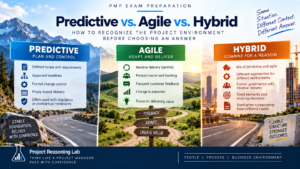
Communication and engagement matter in predictive, agile, and hybrid environments.
In a predictive environment, they may involve:
- structured reports,
- formal governance meetings,
- scheduled reviews,
- documented communication channels.
In an agile environment, they may involve:
- product-owner interaction,
- sprint reviews,
- demonstrations,
- frequent feedback,
- direct collaboration.
A hybrid project may combine both.
The methods may change.
The underlying questions do not:
What information does the stakeholder need?
How should the stakeholder be involved?
11. The Project Reasoning Lab Three-Question Test
When a PMP scenario involves a stakeholder problem, ask three questions.
Question 1: Is the primary problem about information?
Ask:
- Is the stakeholder receiving the right information?
- At the right time?
- In the right format?
- Through the right channel?
- From the right person?
If not, think:
Communications Management Plan
Question 2: Is the primary problem about involvement or support?
Ask:
- Are expectations aligned?
- Is the stakeholder appropriately involved?
- Has support declined?
- Is resistance affecting the project?
- Does the stakeholder need a different engagement strategy?
If so, think:
Stakeholder Engagement Plan
Question 3: Is one problem causing the other?
Ask:
- Is poor communication reducing engagement?
- Is poor engagement causing communication to be ignored?
- Does the scenario require both plans to be reviewed?
This is where deeper reasoning begins.
12. Quick Comparison
| Communications Management Plan | Stakeholder Engagement Plan |
|---|---|
| Focuses on information flow | Focuses on involvement and support |
| What should be communicated? | How should stakeholders be engaged? |
| Who needs the information? | Who needs different involvement? |
| When should information be sent? | What engagement level is appropriate? |
| Which method or channel should be used? | How should resistance or support be addressed? |
| Who sends the information? | How should expectations be aligned? |
| Supports engagement | Guides participation and relationships |
The two plans are connected.
But their primary purposes are different.
Final Takeaway
When a PMP scenario involves stakeholders, do not automatically choose a communication answer just because someone is unhappy.
Ask what is actually wrong.
If the problem is:
Who needs what information, when, how, and from whom?
Think:
Communications Management Plan
If the problem is:
How should this stakeholder be involved, supported, influenced, or aligned?
Think:
Stakeholder Engagement Plan
Then ask one more question:
Is one problem causing the other?
A stakeholder can receive every report and still be disengaged.
A stakeholder can strongly support the project and still receive poor communication.
The key is not choosing the document with the most familiar keyword.
It is understanding what problem the project manager is actually trying to solve.
One thought on “Stakeholder Engagement Plan vs. Communications Management Plan: How to Tell the Difference on the PMP Exam”
Comments are closed.