PMP 2026 Domains Explained: People, Process, and Business Environment
 admino
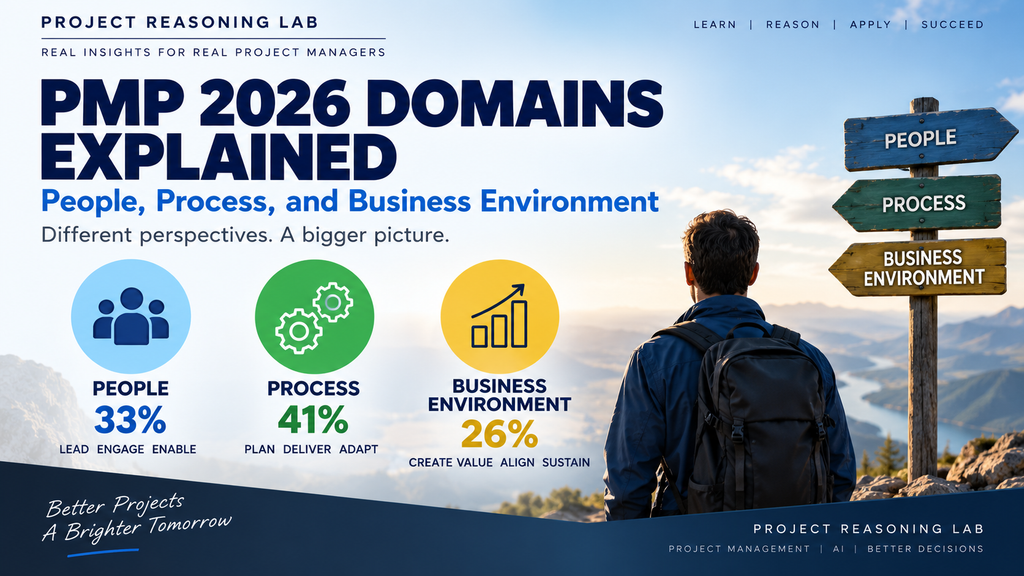
The July 2026 PMP® exam keeps the familiar three-domain structure—People, Process, and Business Environment—but the balance among those domains has changed significantly.
- People: 33%
- Process: 41%
- Business Environment: 26%
The most important shift is the expansion of Business Environment, which increased from 8% on the previous exam to 26% in the July 2026 version. PMI also places greater emphasis on outcomes, value, AI, sustainability, stakeholder engagement, and real-world project dynamics.
But candidates should not treat these three domains as separate boxes.
A single PMP scenario can involve a team problem, a delivery decision, and a business consequence at the same time.
The key idea: Don’t prepare for People, Process, and Business Environment as three separate exams. Learn how they interact when a project manager has to make a decision.
1. People — 33%
The People domain is about creating the human conditions necessary for project success.
It includes leadership, conflict management, stakeholder engagement, collaboration, communication, team performance, and aligning expectations.
A project can have an excellent schedule and a strong technical plan but still fail if:
- team members do not trust each other,
- stakeholders are disengaged,
- expectations are unclear,
- conflict is ignored,
- responsibilities are misunderstood.
That is why PMP questions often ask what the project manager should do, not simply what a term means.
For example, if two experienced team members disagree about a technical approach, immediate escalation is not necessarily the best response.
A stronger first step may be to understand the source of the disagreement and facilitate resolution.
A useful People principle
Understand before escalating.
Before taking action, ask:
- Who is affected?
- What is causing the problem?
- Are expectations aligned?
- Does the team need coaching or facilitation?
- Can the issue be resolved collaboratively?
The exam often rewards situational leadership rather than automatic escalation.
2. Process — 41%
At 41%, Process remains the largest PMP domain.
But Process is not simply about memorizing procedures.
It is about how the project manager organizes, coordinates, monitors, and adapts delivery.
This includes areas such as:
- project planning,
- scope,
- resources,
- procurement,
- dependencies,
- delivery approaches,
- value delivery,
- monitoring and control.
The important question is not only:
“Are we following the plan?”
It is also:
“Is the plan still helping us deliver the right outcome?”
Process is increasingly connected to value
Suppose a project is delivering exactly what was originally approved, but market conditions change and the solution is no longer expected to generate the intended benefit.
Continuing simply because the scope was approved may not be enough.
The project manager should recognize the change, analyze its impact, engage the appropriate stakeholders, and follow the relevant governance or change process.
So Process is not blind adherence to a plan.
It is disciplined delivery that continues to support value.
3. Predictive, Agile, and Hybrid Approaches
Predictive, adaptive/agile, and hybrid approaches appear throughout all three PMP domains.
PMI states that approximately 40% of exam items represent predictive approaches, while the remaining 60% are divided between adaptive/agile and hybrid approaches.
This means candidates should avoid thinking:
People = agile
Process = predictive
Business Environment = strategy
That is not how the exam is structured.
Instead, ask:
What delivery environment am I in, and what behaviour is appropriate here?
A regulated infrastructure project may require substantial predictive planning.
A digital product with rapidly changing customer needs may use adaptive delivery.
A large transformation may combine both.
The project manager’s task is to understand the context and tailor the approach.
4. Business Environment — 26%
The biggest structural change in the 2026 exam is the expansion of Business Environment to 26%.
This reflects a broader view of project success.
Projects do not exist in isolation. They operate within organizations, industries, regulatory environments, markets, and strategic priorities.
Business Environment therefore asks candidates to think about issues such as:
- governance,
- compliance,
- business value,
- benefits,
- organizational strategy,
- external conditions,
- change,
- risk,
- sustainability.
A project can be delivered on time and within budget and still fail if it no longer creates meaningful value.
That is why the project manager increasingly needs to ask not only:
“Can we deliver this?”
but also:
“Should we still deliver this, and what value will it create?”
5. Governance and Compliance Matter
The project manager does not have unlimited authority.
Some decisions may belong to:
- the sponsor,
- a steering committee,
- a product owner,
- a change authority,
- a compliance function,
- senior management.
The exam may therefore test whether you understand when to act directly, when to collaborate, and when escalation is appropriate.
Compliance is equally important.
Imagine that meeting a delivery date would require skipping a mandatory regulatory review.
Finishing on time does not make that decision correct.
A project cannot be considered successful if it achieves its delivery target by violating mandatory requirements.
6. How the Three Domains Overlap
Consider this scenario:
A company is developing an AI-enabled customer service platform.
During testing, the team discovers that the AI system produces inconsistent recommendations for certain customer groups. The sponsor still wants to maintain the original launch date.
This one situation touches all three domains.
People
The project manager must engage the development team, sponsor, compliance specialists, and affected stakeholders.
There may be disagreement about how serious the problem is.
Process
The project manager must assess the defect, analyze the impact, determine what work is required, and evaluate schedule implications.
Business Environment
The project manager must consider governance, ethics, regulatory requirements, reputational risk, and the consequences of releasing an unreliable system.
The question is not:
“Which domain does this belong to?”
It belongs to all three.
The real challenge is:
“What should the project manager do next?”
That is where reasoning begins.
7. The Project Reasoning Lab Three-Lens Check
When you encounter a PMP scenario, examine it through three lenses.
People lens
Ask:
- Who is affected?
- Who needs to be involved?
- Is there conflict?
- Are expectations aligned?
- Does someone need coaching, facilitation, or engagement?
Process lens
Ask:
- What process applies?
- Has the impact been analyzed?
- Is this a risk, issue, change, dependency, or quality problem?
- Does the plan need to change?
- What should happen first?
Business Environment lens
Ask:
- What is the business impact?
- Is value still being created?
- Are governance rules involved?
- Are there compliance requirements?
- Have external conditions changed the decision?
Then combine the three.
That is much closer to how real project-management decisions are made.
8. How to Study the Three Domains
The domain percentages are useful for allocating study time, but they should not become rigid boundaries.
Yes, Process has the largest weighting.
Yes, Business Environment deserves much more attention than it did previously.
But many exam questions combine several domains.
A stakeholder conflict may affect business value.
A compliance change may affect scope.
A technical issue may require governance escalation.
For each concept you study, ask:
How would this appear in a real project scenario?
Instead of simply memorizing a definition of risk, ask:
What changes when the risk actually occurs?
Instead of memorizing stakeholder engagement terminology, ask:
What should the project manager do if an influential stakeholder suddenly opposes the project?
Instead of memorizing governance concepts, ask:
Which decisions can the project manager make directly, and which require approval?
That is how knowledge becomes judgment.
9. What the 2026 Domain Structure Tells Us
The new weighting reflects a broader definition of the project manager’s role.
PMI says the refreshed exam places greater emphasis on business alignment, strategic decision-making, sustainability, and real-world delivery in AI-enabled environments.
The project manager is increasingly expected to combine:
- leadership,
- delivery knowledge,
- stakeholder judgment,
- business awareness,
- governance,
- adaptability,
- value orientation.
People still matter.
Process still matters.
But project success increasingly depends on understanding why the project matters and what impact it creates.
Final Takeaway
The three PMP domains can be summarized simply:
People asks:
How do we lead, communicate, collaborate, and engage?
Process asks:
How do we organize and deliver the work effectively?
Business Environment asks:
Why does the project matter, and how does it fit within the organization and its environment?
Strong PMP candidates understand all three.
Stronger candidates understand how they interact.
When working through a scenario, ask:
What is happening?
Who is affected?
What process applies?
What is the business impact?
What should happen first?
That is the shift from memorizing project management to reasoning like a project manager.
And that is the mindset behind Project Reasoning Lab.

2 thoughts on “PMP 2026 Domains Explained: People, Process, and Business Environment”
Comments are closed.