Risk vs. Issue on the PMP Exam: How to Tell the Difference
 admino
Risk vs. Issue on the PMP Exam: How to Tell the Difference
Risk and issue are two of the simplest project-management concepts to define.
They are also surprisingly easy to confuse in a PMP® scenario.
The basic distinction is straightforward:
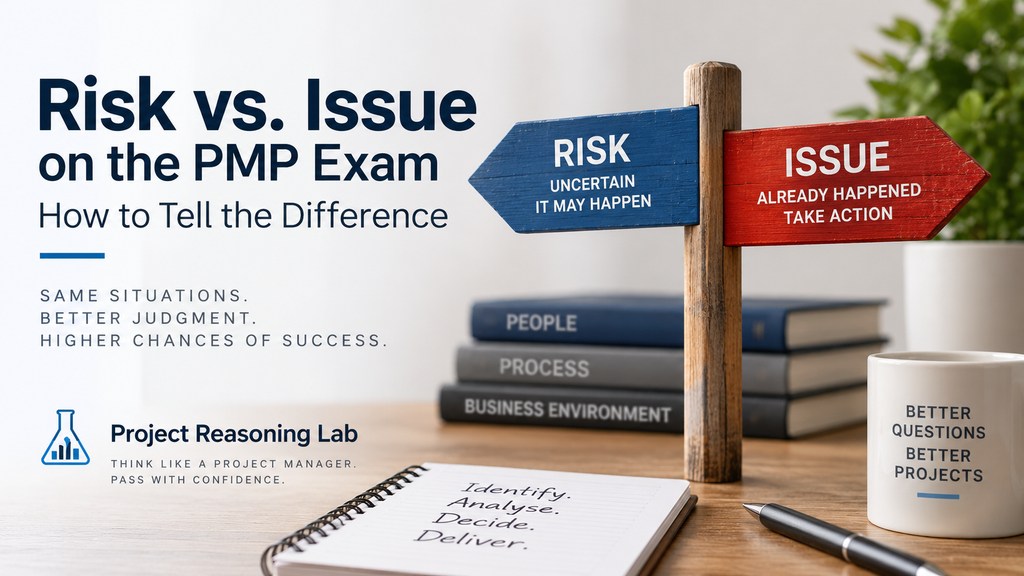
A risk is uncertain. It may happen.
An issue has already happened or is happening now.
But the PMP exam rarely stops at asking for that definition.
Instead, you may receive a scenario containing uncertainty, warning signs, consequences, stakeholders, deadlines, and several reasonable-looking actions.
Your job is to determine what is actually happening — and then decide what the project manager should do next.
That is where the distinction between a risk and an issue becomes important.
1. Start With One Question: Has It Happened?
When reading a scenario, begin with the timeline.
Ask:
Has the event actually occurred?
Consider these two statements:
A critical supplier may be unable to deliver a component next month.
The supplier has not failed to deliver yet.
That is a risk.
Now consider:
The supplier has informed the project manager that the component will be delivered three weeks late.
The uncertainty is gone.
The delay now exists.
That is an issue.
This distinction changes what the project manager should do.
A risk requires preparation for uncertainty.
An issue requires action on a current situation.
2. Risk Means Uncertainty
A project risk is an uncertain event or condition that could affect project objectives.
The word uncertain matters.
Something might happen.
It might not.
The project manager therefore thinks in terms of:
- probability,
- impact,
- response strategies,
- triggers,
- contingency actions,
- risk ownership,
- monitoring.
Imagine that a team relies on a specialist who may leave the organization before a critical implementation.
Nothing has happened yet.
The project manager might:
- identify the risk,
- analyze its probability and impact,
- determine an appropriate response,
- assign responsibility,
- monitor for warning signs.
The objective is not to solve an event that has already happened.
It is to prepare intelligently for uncertainty.
3. An Issue Exists Now
An issue is different.
Suppose the specialist resigns.
The project no longer faces the possibility of losing that resource.
The resource has been lost.
The project manager now needs to understand the consequences.
Questions may include:
- Which activities are affected?
- Does the schedule need to change?
- Is replacement expertise available?
- Does the sponsor need to be informed?
- Is a formal change required?
- Is a contingency response already available?
The project manager has moved from risk management to issue management.
A useful PMP reasoning rule is:
Future uncertainty → manage the risk.
Present reality → manage the issue.
An issue does not necessarily mean something negative. It simply means that a situation requiring attention now exists.
4. Look for Language That May Signal Risk or Issue
PMP scenarios often reveal the distinction through wording, but keywords should be treated as clues, not automatic answers.
Language that may signal a risk
Words and phrases may include:
- may,
- might,
- could,
- potentially,
- if,
- possibility,
- concern that,
- probability.
For example:
The project manager learns that new legislation may be introduced during the project.
The event is uncertain.
That suggests a risk.
Language that may signal an issue
Words and phrases may include:
- has occurred,
- has informed,
- discovered,
- failed,
- delayed,
- refuses,
- is unavailable,
- has changed,
- does not meet.
For example:
During testing, the team discovers that the product does not meet a regulatory requirement.
The problem exists now.
That suggests an issue.
Do not rely on a single word, however.
Always interpret the full situation.
5. When a Risk Becomes an Issue
This transition is especially important.
Imagine that a risk register contains this entry:
If severe weather occurs during site preparation, construction may be delayed.
The project team creates a contingency response.
Two months later, severe flooding closes the construction site.
What changed?
Before the flood:
Risk
After the flood:
Issue
The important PMP reasoning question now becomes:
Was a response already planned?
If a documented contingency response exists and its trigger has occurred, implementing that response may be more appropriate than starting an entirely new analysis.
This is one reason risk management matters.
Planning before an uncertain event occurs can make the response much faster if the event actually happens.
6. Don't Keep Treating an Issue Like a Risk
A common reasoning mistake is continuing to analyze the probability of something that has already happened.
Suppose a software vendor announces that it cannot deliver an integration by the agreed date.
At this point, asking:
“How likely is it that the vendor will miss the date?”
does not make sense.
The vendor has already said it will miss the date.
The question now becomes:
“What impact does this have, and what should we do about it?”
This distinction can eliminate an attractive but incorrect answer in a PMP scenario.
7. Risk Does Not Always Mean Something Negative
Another common mistake is assuming that risk automatically means danger.
Uncertainty can create either:
- a threat, or
- an opportunity.
Suppose a new technology could allow the project team to complete a major activity considerably faster than planned.
The benefit is not guaranteed.
That uncertainty may represent an opportunity.
The project manager should evaluate it rather than ignore it simply because the possible outcome is positive.
Risk management is therefore not only about preventing bad things.
It is about managing uncertainty intelligently.
8. Risk vs. Issue vs. Change
PMP scenarios can become more difficult when one situation contains several concepts at once.
Consider:
A customer discovers that a regulatory requirement has changed and asks the project team to modify the product.
Several things are happening.
The regulatory requirement has already changed, so the project now faces a current condition that must be addressed.
That is an issue.
The customer's requested modification may then require a change to the project.
Implementing that change may create additional risks affecting cost, schedule, resources, quality, or other objectives.
The sequence might therefore look like this:
Existing condition → Issue → Requested modification → Change → New uncertainty → Risk
This is why PMP scenarios cannot always be solved by assigning them to a single category.
Do not ask only:
“What category is this?”
Ask:
“What happened first, and what does that require the project manager to do next?”
9. Scenario: A Supplier Warning
Consider this example.
A supplier tells the project manager that shortages in its industry are increasing and that a critical component may be unavailable in six weeks.
What should the project manager recognize first?
The component has not yet become unavailable.
The project therefore faces a risk.
The project manager should not immediately behave as though delivery has already failed.
Instead, the manager should understand and analyze the uncertainty and determine an appropriate response.
Now change one sentence:
The supplier tells the project manager that the critical component will not be available for the scheduled delivery.
The situation is no longer uncertain.
Now there is an issue requiring action.
A small change in wording completely changes the reasoning.
10. One More Example: A Key Team Member
Suppose a senior developer tells the project manager:
“I'm considering accepting another job.”
The developer has not left.
That creates uncertainty and therefore may represent a risk.
Now imagine the developer says:
“I accepted another position. My final day is Friday.”
The uncertainty is gone.
The project manager now has an issue to manage.
The distinction is temporal:
Before occurrence: risk.
After occurrence: issue.
11. What Should the Project Manager Do First?
This is where PMP reasoning becomes more important than terminology.
After identifying whether something is a risk or an issue, ask what information already exists.
For a risk, consider:
- Has it already been identified?
- Has it been analyzed?
- Is there an owner?
- Is there a response plan?
- Has a trigger occurred?
For an issue, consider:
- What actually happened?
- What is the impact?
- Who is affected?
- Is an existing response applicable?
- Can the project manager resolve it?
- Is governance or escalation required?
The correct action depends on the situation.
There is no universal rule saying:
“Every issue must immediately be escalated.”
Nor should every risk automatically generate a change request.
First, understand the situation.
Then act.
12. The Project Reasoning Lab Test
When a PMP scenario appears to involve a risk or an issue, use this simple sequence.
Question 1: Has it happened?
No → Risk
Yes → Issue
Question 2: Was it anticipated?
If yes, check whether a planned response already exists.
Question 3: What is the impact?
Consider:
- scope,
- schedule,
- cost,
- quality,
- resources,
- stakeholders,
- compliance,
- business value.
Question 4: Who has authority?
Determine whether the project manager can act directly or whether another role must be involved.
Question 5: What should happen first?
Do not jump automatically to escalation or formal change.
Identify the most appropriate immediate action based on the information available.
13. Risk vs. Issue: Quick Comparison
| Risk | Issue |
|---|---|
| Uncertain | Has occurred or exists now |
| Future possibility | Present reality |
| Probability matters | Probability of occurrence no longer matters |
| Analyze and prepare | Assess and respond |
| May require a response plan | May require corrective action |
| Managed as uncertainty | Managed as a current situation |
The distinction itself is simple.
Applying it correctly inside a complex scenario is harder.
Final Takeaway
A risk is uncertain.
An issue exists now.
But on the PMP exam, recognizing the label is only the beginning.
The harder question is:
What does that distinction mean for the next action?
Ask:
What happened?
What is already known?
Is there already a response?
Who has authority?
What should happen first?
That is the difference between memorizing terminology and reasoning like a project manager.