Why Business Environment Matters Much More on the 2026 PMP Exam
 admino
For years, many PMP® candidates treated the Business Environment domain as a relatively small part of the exam.
That is no longer a safe strategy.
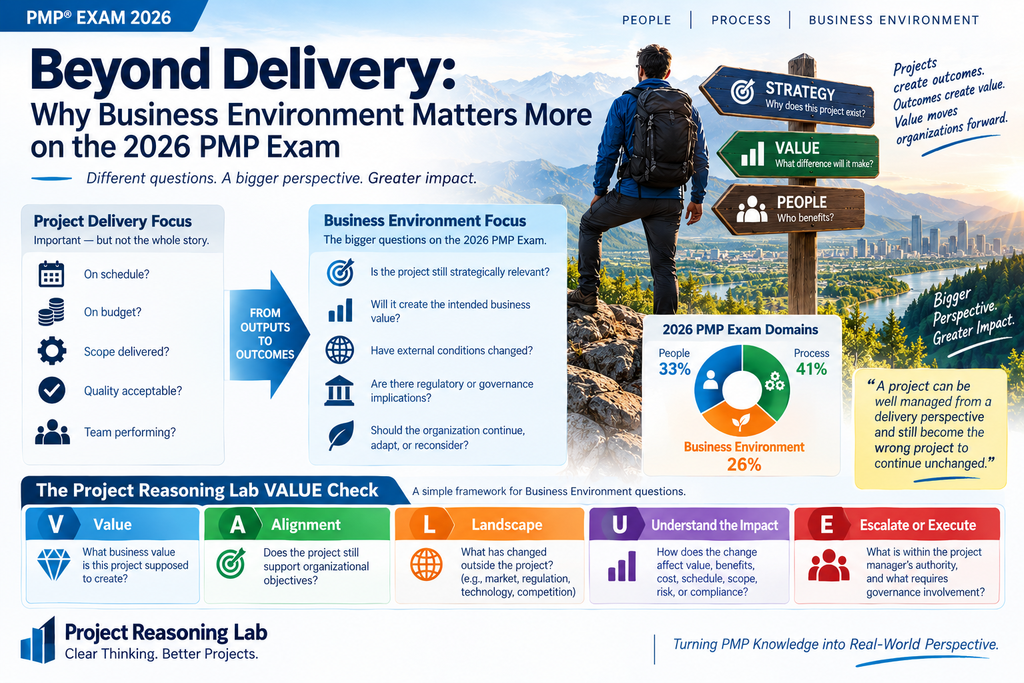
In the July 2026 PMP exam, Business Environment represents 26% of the exam, compared with 8% previously.
But the important change is not only the percentage.
The updated exam expects candidates to think beyond project execution and consider:
- business value,
- strategic alignment,
- governance,
- compliance,
- external change,
- expected benefits,
- organizational impact.
That reflects a broader view of project success.
A project can be well managed from a delivery perspective and still become the wrong project to continue unchanged.
So the Business Environment domain asks a larger question:
Why does this project matter, and is it still creating the value the organization expects?
1. Business Environment Is Now a Major PMP Domain
The 2026 PMP exam is divided into three domains:
| Domain | 2026 Exam Weight |
|---|---|
| People | 33% |
| Process | 41% |
| Business Environment | 26% |
Business Environment now represents more than one quarter of the exam.
That means candidates cannot treat it as a minor collection of business terminology.
Instead, they need to understand how project decisions connect to:
- organizational objectives,
- expected benefits,
- governance,
- regulation,
- external conditions,
- long-term value.
The project manager is still responsible for delivery.
But delivery now needs to be understood in a wider context.
2. Delivery Success and Business Value Are Different Questions
Project management often focuses on delivery questions such as:
- Are we on schedule?
- Are costs controlled?
- Is scope being delivered?
- Is quality acceptable?
These questions remain important.
But Business Environment introduces another layer:
Is the project still worth doing in the way originally planned?
Consider:
A project is delivered on time and within budget, but customers do not adopt the new product and the expected benefits are not realized.
From a delivery perspective, many things may have gone well.
From a business perspective, there is still a serious problem.
This is why Business Environment questions require candidates to connect project performance with outcomes and value.
3. Deliverables, Outcomes, and Benefits Are Not the Same
A useful distinction is:
Deliverable
What the project produces.
Example:
A new customer-service platform
Outcome
What changes because the deliverable is used.
Example:
Customers receive faster service
Benefit or Business Value
Why that outcome matters to the organization.
Example:
- lower support costs,
- stronger customer retention,
- increased satisfaction,
- higher revenue.
A team can successfully produce the deliverable without necessarily achieving the expected outcome.
And an outcome can occur without producing the level of business benefit originally expected.
That is why PMP candidates should ask:
What value was this project supposed to create?
4. External Conditions Can Change the Business Case
Projects operate inside a larger environment.
Conditions outside the project may change even when the project team is performing well.
Examples include:
- new regulation,
- economic change,
- competitor activity,
- new technology,
- supplier instability,
- changing customer expectations,
- organizational restructuring,
- sustainability requirements.
Imagine:
A company begins developing a proprietary platform. One year later, a commercially available alternative enters the market at a fraction of the expected remaining project cost.
The original project may still be technically achievable.
The schedule may still be manageable.
But the economic logic has changed.
The question becomes:
Does continuing in the same way still create sufficient value?
That may require reassessing:
- benefits,
- costs,
- alternatives,
- risks,
- strategic alignment.
The project manager does not control the external environment.
But the project manager should recognize when it changes the project’s business context.
5. Strategic Alignment Matters
Projects exist because organizations expect them to support an objective.
That objective may involve:
- revenue growth,
- cost reduction,
- regulatory compliance,
- improved customer experience,
- operational efficiency,
- market expansion,
- risk reduction,
- transformation.
Now suppose the organization changes strategy halfway through the project.
The appropriate response is not necessarily:
“The project was approved, so continue exactly as planned.”
Instead, ask:
Does the project still support the organization’s current objectives?
The project manager may need to:
- assess the impact,
- review expected benefits,
- identify alternatives,
- provide recommendations,
- involve the appropriate governance authority.
The project manager does not necessarily own the strategic decision.
But the project manager should understand its implications.
6. Governance Determines Who Can Decide
Business Environment questions often involve decisions that extend beyond normal project authority.
Examples may include:
- major funding changes,
- strategic shifts,
- portfolio priorities,
- contractual exposure,
- benefit expectations,
- regulatory issues.
The project manager may be responsible for:
- identifying the situation,
- gathering evidence,
- analyzing impact,
- developing options,
- recommending a response.
But the final decision may belong to:
- the sponsor,
- steering committee,
- portfolio leadership,
- executive management,
- compliance,
- another governance body.
This connects to a recurring Project Reasoning Lab question:
Who owns the decision?
Good project management does not mean making every decision personally.
It means recognizing when the decision belongs elsewhere.
7. Compliance Can Limit the Available Options
Consider:
A project team discovers that the planned solution conflicts with a new regulatory requirement.
The project manager should not simply continue unchanged because modifying the project would affect the schedule.
The situation may require:
- compliance review,
- legal input,
- impact analysis,
- governance involvement,
- changes to scope or design,
- revised cost or schedule estimates.
The important principle is:
Schedule pressure does not override mandatory requirements.
Business Environment reasoning means recognizing when regulation, policy, contractual obligations, or governance constrain the available choices.
8. Scenario: The Project Is Performing Well, but Demand Has Changed
Consider:
A project is on schedule and within budget. New market research now shows that customer demand for the planned product has declined substantially.
The obvious project-control indicators look good.
But the business context has changed.
The project manager should not conclude:
“Everything is fine because schedule and cost are on target.”
Instead, the new information may require:
- reassessing expected benefits,
- evaluating the effect on the business case,
- discussing implications with the sponsor,
- considering whether the project should continue unchanged, adapt, or be reconsidered.
The distinction is important:
A project can perform well operationally while becoming less valuable strategically.
9. The Project Reasoning Lab VALUE Check
When a PMP scenario involves business context, use the VALUE Check.
V — Value
Ask:
What business value or benefit is this project supposed to create?
What justified the project originally?
A — Alignment
Ask:
Does the project still support organizational objectives?
Has strategy or priority changed?
L — Landscape
Ask:
What has changed outside the project?
Consider:
- regulation,
- markets,
- customers,
- technology,
- competition,
- organizational conditions.
U — Understand the Impact
Ask:
How does the change affect the project and its expected benefits?
Consider:
- value,
- benefits,
- cost,
- schedule,
- scope,
- risk,
- compliance.
E — Escalate or Execute Appropriately
Ask:
What action is within the project manager’s authority, and what requires governance involvement?
The project manager may need to:
- analyze,
- communicate,
- recommend,
- update plans,
- escalate,
depending on the situation.
10. Business Environment Is Not the Same as “Business Expertise”
PMP candidates do not need to become economists, strategists, or corporate executives.
The exam is not asking you to run the company.
It is asking whether you can connect project decisions to the organization and environment around the project.
A practical way to think about Business Environment is:
What changed, why does it matter, and who needs to respond?
That question resolves many scenarios.
Quick Comparison
| Delivery-Focused Question | Business Environment Question |
|---|---|
| Was the work delivered? | Did the project create the intended value? |
| Is the schedule on track? | Is the project still strategically relevant? |
| Are costs controlled? | Are expected benefits still worth the investment? |
| Is scope being delivered? | Are the outcomes still useful? |
| Is the project plan being followed? | Has the external environment changed? |
| Can the team deliver? | Should the organization continue, adapt, or reconsider? |
Both perspectives matter.
The Business Environment domain asks candidates to connect them.
Final Takeaway
Business Environment matters much more on the 2026 PMP exam because project success is not judged only by:
scope, schedule, cost, and delivery.
Candidates also need to think about:
- value,
- outcomes,
- benefits,
- strategic alignment,
- governance,
- compliance,
- external change.
So when a PMP scenario introduces a business change, ask:
What value was this project supposed to create?
Is that value still relevant?
Has strategy or the external environment changed?
What is the impact?
Who has authority to respond?
A project can be well managed from a delivery perspective and still become the wrong project to continue unchanged.
Deliver the project—but never lose sight of why the project exists.