AI and Sustainability on the 2026 PMP Exam: What Project Managers Need to Understand
 admino
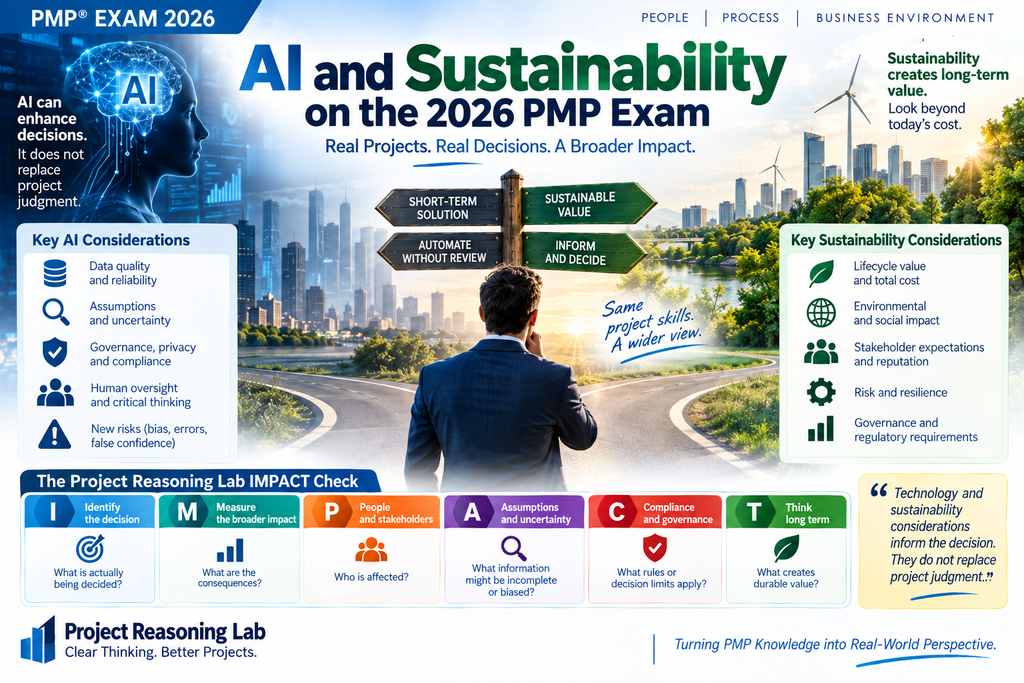
Artificial intelligence and sustainability are more visible in the 2026 PMP® exam.
But candidates should not expect the exam to turn into an AI certification or a sustainability certification.
These topics are more likely to appear inside project scenarios, where the project manager must evaluate evidence, trade-offs, governance, risk, stakeholders, and long-term value.
So the real question is not:
“Do I know enough AI terminology?”
or:
“Can I define sustainability?”
The better question is:
“How should a project manager reason when AI or sustainability changes the decision?”
That is where the topic becomes practical.
1. AI and Sustainability Are Part of the Decision Context
A PMP scenario may involve:
- an AI-generated forecast,
- an automated risk recommendation,
- an AI-assisted resource decision,
- sustainability requirements,
- lifecycle costs,
- environmental impacts,
- long-term business consequences,
- governance or compliance concerns.
The exam may then ask what the project manager should do next.
The important task is not simply to recognize the topic.
It is to determine:
What does this information mean for the project decision?
2. AI Is an Input — Not the Decision
Suppose an AI tool recommends shortening the testing period because historical data suggests the defect rate will remain low.
Should the project manager automatically follow the recommendation?
No.
The AI output is evidence.
It is not automatically the decision.
The project manager still needs to consider:
- risk,
- quality requirements,
- contractual obligations,
- stakeholder impact,
- governance,
- compliance,
- current project conditions.
A useful principle is:
AI can support judgment. It does not replace responsibility for judgment.
Human oversight still matters because not every relevant factor is necessarily represented in the model.
3. Question the Data, Assumptions, and Uncertainty
AI-generated output can look precise and authoritative.
That does not mean it is reliable.
Consider:
An AI forecasting tool predicts that a critical activity will finish on time.
Before acting on that prediction, the project manager should ask:
- What data was used?
- Is the data current?
- Does it reflect this project’s conditions?
- Are important dependencies missing?
- What assumptions are built into the model?
- How uncertain is the result?
Data quality matters.
If the input is:
- incomplete,
- outdated,
- biased,
- inconsistent,
- poorly classified,
the output may also be unreliable.
A polished recommendation can still be based on weak evidence.
This leads to another useful principle:
The presence of AI should not reduce critical thinking. It should often increase it.
4. Governance and AI Risk Still Apply
AI can improve project work in areas such as:
- forecasting,
- scheduling,
- reporting,
- scenario analysis,
- risk identification,
- resource planning.
But it can also introduce new risks, including:
- bias,
- privacy concerns,
- confidentiality issues,
- intellectual-property concerns,
- model error,
- lack of explainability,
- false confidence,
- dependency on poor data.
Consider:
A team wants to upload confidential customer information into a public AI tool to accelerate analysis.
The project manager should not focus only on productivity.
The decision may involve:
- privacy,
- organizational policy,
- information security,
- contractual restrictions,
- regulatory requirements.
Technology does not override governance.
The correct reasoning is not:
Use AI whenever possible
or:
Avoid AI because it is risky
It is:
Use AI appropriately, understand its limitations, and manage the risks it creates.
5. Sustainability Means Looking Beyond Immediate Delivery
Sustainability is often reduced to:
“Is this environmentally friendly?”
That is too narrow.
In a project context, sustainability may involve:
- lifecycle cost,
- resource use,
- resilience,
- environmental impact,
- stakeholder consequences,
- operational efficiency,
- long-term organizational value.
Consider:
A cheaper material reduces project cost today but requires substantially more maintenance over the next five years.
The lowest initial cost may not create the strongest overall value.
The project manager may need to consider:
- total lifecycle cost,
- reliability,
- maintenance,
- energy use,
- waste,
- customer expectations,
- long-term benefits.
The important question becomes:
What creates the strongest value over the relevant lifecycle?
6. Sustainability Also Affects Risk and Stakeholders
Suppose a supplier offers the lowest price but has a poor environmental and labor record.
The immediate project cost may look attractive.
But broader consequences may include:
- reputational risk,
- stakeholder opposition,
- regulatory exposure,
- supply-chain disruption,
- customer concern,
- future cost.
Sustainability therefore connects directly with:
- risk,
- procurement,
- stakeholder engagement,
- governance,
- business value.
It is not a separate topic floating outside normal project management.
And just as with AI, avoid simplistic rules.
A more sustainable option is not automatically the correct option merely because it has environmental benefits.
The project manager still needs to evaluate:
- feasibility,
- cost,
- value,
- risk,
- requirements,
- governance,
- authority.
7. Scenario: AI Recommends a Schedule Change
Consider:
An AI scheduling tool recommends compressing several activities to recover a delay.
Should the project manager implement the recommendation immediately?
Not necessarily.
The recommendation may be useful, but the manager still needs to consider:
- resource capacity,
- quality,
- dependencies,
- cost,
- risk,
- stakeholder commitments.
The important reasoning is:
AI recommendation → evaluate impact → decide appropriately
not:
AI recommendation → automatic action
8. Scenario: The Sustainable Option Costs More
Now consider:
A supplier proposes a more sustainable component that costs 8% more initially but is expected to reduce maintenance, waste, and energy use over the product lifecycle.
Should the project manager reject it because it increases the immediate project cost?
Not automatically.
The decision may require:
- lifecycle analysis,
- stakeholder input,
- budget review,
- benefits evaluation,
- governance approval.
The relevant question is:
Which option creates better overall value while meeting project and organizational requirements?
The initial price is only one part of the decision.
9. The Project Reasoning Lab IMPACT Check
AI and sustainability are different topics.
But both require disciplined reasoning.
Use the IMPACT Check.
I — Identify the Decision
Ask:
What decision is actually being made?
Do not let the technology or sustainability label distract from the underlying project question.
M — Measure the Broader Impact
Ask:
What consequences does this choice create?
Consider:
- cost,
- schedule,
- quality,
- risk,
- benefits,
- business value,
- long-term effects.
P — People and Stakeholders
Ask:
Who is affected?
Consider:
- customers,
- team members,
- suppliers,
- regulators,
- executives,
- communities.
A — Assumptions and Uncertainty
Ask:
What information may be incomplete, biased, uncertain, or based on assumptions?
This is especially important when using AI-generated recommendations.
C — Compliance and Governance
Ask:
What legal requirements, policies, controls, or decision limits apply?
Innovation does not remove governance.
T — Think Long Term
Ask:
What does this decision mean beyond immediate delivery?
Consider:
- lifecycle cost,
- resilience,
- sustainability,
- future risk,
- durable value.
10. Do Not Choose by Buzzword
Do not choose an answer simply because it sounds:
- more technological,
- more innovative,
- more automated,
- more sustainable,
- more environmentally responsible.
The correct response still depends on:
- evidence,
- assumptions,
- impact,
- authority,
- governance,
- context.
The PMP exam is still testing project judgment.
Quick Comparison
| AI Context | Sustainability Context |
|---|---|
| Is the data reliable? | What is the lifecycle impact? |
| What assumptions are built into the model? | What are the long-term costs and benefits? |
| Is human review needed? | Who is affected over time? |
| Are there privacy or bias concerns? | What environmental or social effects matter? |
| What governance applies? | What regulatory or governance requirements apply? |
| Does the recommendation improve value? | Does the option create durable value? |
The topics are different.
The reasoning discipline is similar.
Final Takeaway
AI and sustainability matter on the 2026 PMP exam because they reflect how real project decisions are becoming more complex.
But the exam is not asking candidates to become AI engineers or sustainability specialists.
It is asking them to think like project leaders.
When AI appears, ask:
What does the tool know?
What assumptions might be weak?
What risks and governance requirements apply?
When sustainability appears, ask:
What is the broader impact?
What happens over the full lifecycle?
What creates durable value?
And in both cases, remember:
Technology and sustainability considerations inform the decision. They do not replace project judgment.
That is the real skill the exam is testing.